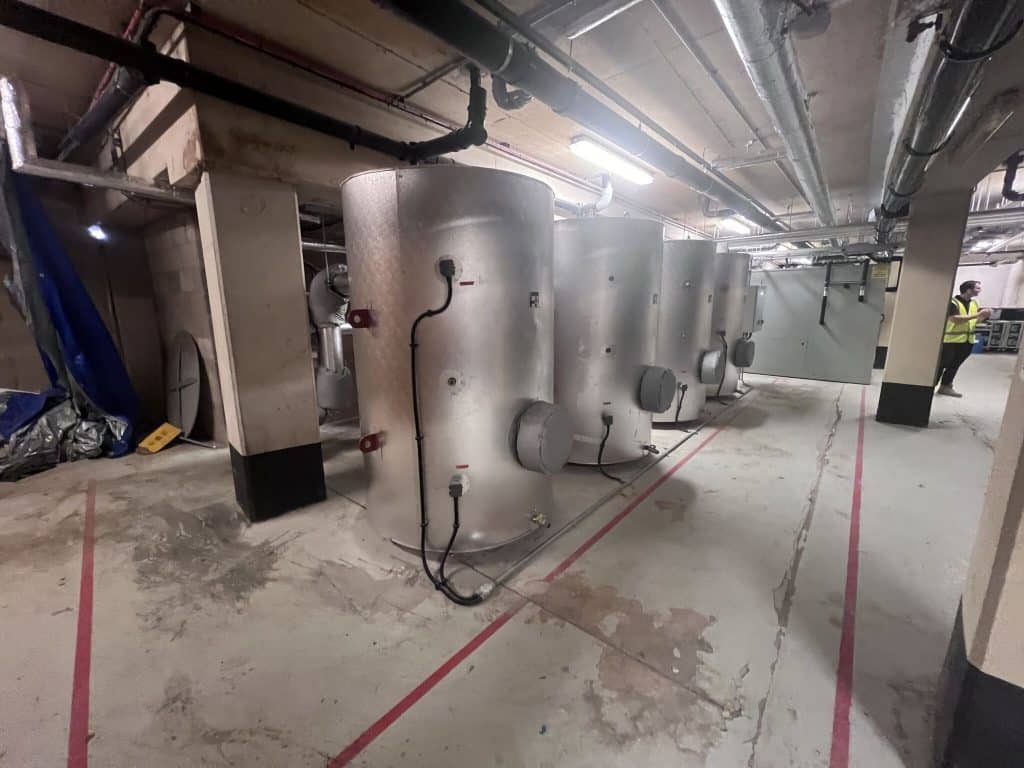
Most commercial heat pumps require a minimum buffer volume to support reverse-cycle defrost.
But Clade heat pumps use hot gas defrost, removing this requirement and allowing designers greater flexibility when sizing buffer vessels.
Here, we’ll share why we believe hot gas defrost is beneficial for heat pump systems, and offer buffer vessel specification recommendations for the commercial heat pumps we manufacture here at Clade.
The benefits of hot gas defrost
When ambient conditions are low, heat pumps need a way to defrost the frost that builds up on their evaporator coils.
At Clade, we’ve chosen to use hot gas defrost to achieve this, meaning hot refrigerant from the heat pump is put through the evaporator.
It’s more technically difficult to achieve than reverse cycle defrost, but it has several advantages:
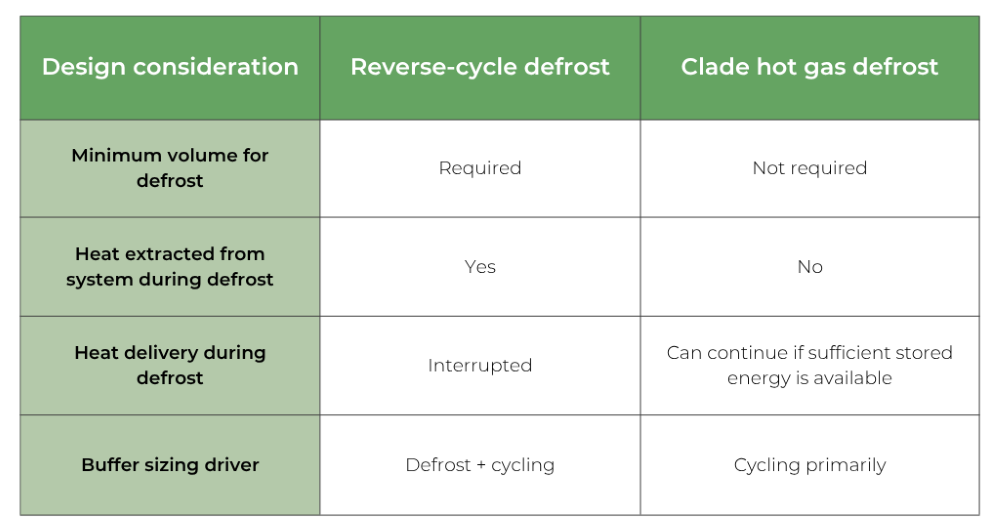
Smaller buffer
Because we don’t use the reverse cycle defrost method, this means that Clade heat pumps don’t require a buffer for defrost purposes.
Although a buffer is still recommended in most cases to protect the heat pump’s compressor, the minimum volume required for this is usually much lower.
That means you can typically get away with a smaller buffer, saving both money and space.
More efficient
Hot gas defrost is more efficient, as it doesn’t involve extracting heat from the system to defrost.
Instead, all the energy that’s been given to the building remains in the building.
No gaps in operation
With reverse-cycle defrost, the building can’t receive heat until the process is complete.
On the other hand, with hot gas defrost, the building can continue to receive heat while your heat pump defrosts – as long as you’re storing enough thermal energy in your buffer to cover those defrost periods.
Do Clade heat pumps still need a buffer tank?
At Clade, we’re one of the only manufacturers of heat pumps that doesn’t require a buffer tank for defrost.
However, we would still recommend buffers for our heat pumps in most cases.
This is because, even though our heat pumps don’t require buffers to defrost, a buffer will still help to protect your heat pump’s compressor by minimising stop-start cycles (and, of course, it can also act as useful thermal storage!).
Ultimately though, it’s up to the designer or consultant on each project to decide whether they want to protect their unit as we suggest – meaning a buffer isn’t essential in the same way as it would be for our competitors.
It’s rare, but we have seen projects in the past where a buffer hasn’t been necessary as a heat pump has been designed to run against a constant load. For instance, in one project, our Acer heat pump fed directly into a swimming pool heat exchanger.
At the end of the day, every project is different!
Buffer tank sizing considerations
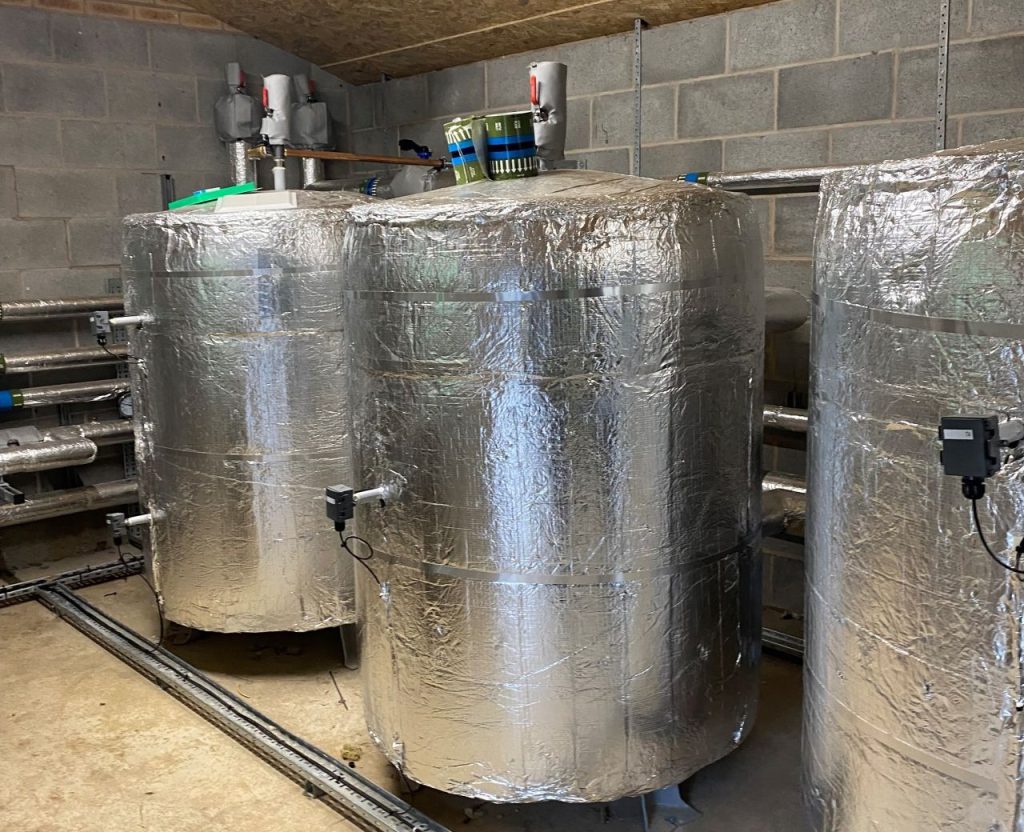
At Clade, our minimum volume requirements are typically very low as they don’t include a minimum volume for defrost.
Instead, our minimum volume is the volume of water that allows the compressor to start up safely.
That said, we also recommend using around 20 minutes of storage to cover the period when your heat pump is defrosting.
This will allow you to heat your building using your buffer while your heat pump is effectively not in action, for around 30 minutes.
Other considerations for buffer sizing include:
- Load profile – peak heat loss vs peak demand
- Grid flexibility – using a buffer for thermal storage can allow an opportunity to take advantage of cheaper nighttime tariffs
- Location – ceiling height and installation constraints may restrict buffer size
- Number of vessels – using multiple vessels can solve space restraints and reduce the portion of unusable water being stored
- Refrigerant – the smaller the Delta T, the larger your buffer vessel will typically need to be
At Clade, we use the natural refrigerants CO2 and propane. Buffer tanks for CO2 systems are typically several times smaller than those for propane systems, as CO2 has a much larger Delta T (up to around 40 degrees, compared to around 10 to 15 degrees).
Clade buffer vessel specification recommendations
If you’re using natural refrigerants, the design and specification of a buffer vessel is very important. After all, natural refrigerants – particularly CO2 – tend to have a wide Delta T.
With that in mind, here are some points that are really important if you’re looking for a buffer vessel for a Clade heat pump.
1. Height to width ratio
In Clade systems, we recommend a tall, skinny buffer vessel – which translates to a height-to-width ratio of at least 2.5 to 1.
This allows the stratification of water (from hot at the top to cold at the bottom) to be maintained, which is important for our control of a heat pump.
If you have a wider, fatter buffer vessel, this can cause those thermal layers to be less defined.
2. Sparge pipes
In Clade systems, buffer vessels should incorporate sparge pipes that distribute flow evenly.
Using sparge pipes allows us to increase the usable volume of that vessel.
3. Baffle plates
Another feature we recommend for our heat pump systems is a perforated baffle plate.
This acts like a barrier to having high velocities in the vessel, and prevents mixing from the top to the bottom – which is especially important for CO2 systems.
4. Combined flow and return header
At Clade, we also prefer a combined flow and return header in and out of the vessel – as opposed to a one-in-one-out design.
These headers need to be properly sized to prevent the velocity from being too high into the vessel. We look for no more than 0.3 mps into the vessel to prevent excessive mixing.
5. Temperature sensors
Lastly, buffer vessels should have temperature sensors evenly distributed across the vessel.
This allows the temperature to be properly monitored, to make sure your buffer is working as efficiently as possible.
Buffers and the Construction (Design and Management) Regulations (CDM)
The Construction (Design and Management) Regulations 2015 (CDM) require designers to consider how plant can be safely maintained in the long run, as well as how it can be safely installed and operated.
Here are a few important considerations when it comes to heat pump systems.
Safe charging
Imagine a heat pump that’s installed 20 stories up, on the roof of a high-rise block of flats. An important consideration from the outset should be how that system will be safely charged.
Ordinarily, this would require having workers carry up to 600 or 700 kilos of gas to the roof in 20-kilo bottles, which would mean a lot of trips.
A smarter option could be to charge the units using charging lines that run from the roof to the ground floor through the building internally.
Minimum clearance
The minimum clearance around any Clade unit is 1 metre all around.
Likewise, if working in an electrical panel, there needs to be a minimum of a meter space, to prevent somebody from getting an electric shock and then becoming trapped.
Safety vent valves
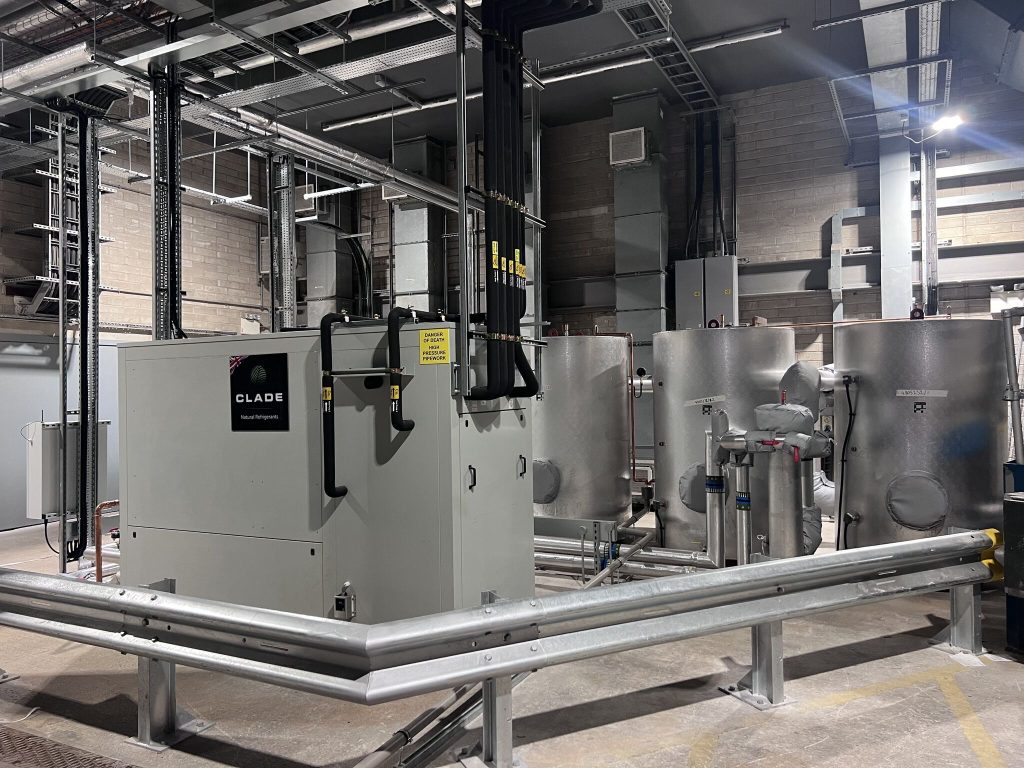
A very common CDM issue with buffer vessels is placing the safety valve on top of the vessel.
This can then make the vessel unmaintainable because the valve is out of reach.
Final thoughts
Buffer vessel design is rarely a one-size-fits-all exercise.
Required system volume, load profile, refrigerant selection, defrost strategy, and plantroom constraints all influence the final specification.
However, one of the key advantages of Clade heat pumps is that hot gas defrost removes the need to size buffer vessels around defrost requirements.
This gives designers added flexibility with buffer sizing, as well as the opportunity to reduce plant space requirements – all while maintaining reliable performance.
Need support with buffer vessel sizing, system design, or heat pump specification? Just get in touch.
Our team works closely with consultants, designers, and contractors across the UK. We’re always happy to help.
]]>
So, you’re looking at transitioning your building away from gas and toward a greener future. You’ve heard the buzz about heat pumps, but you aren’t sure if your building is “ready” or if the project will even fit.
As a building services engineer, I’ve seen everything from “perfect fit” installs to “this is going to be a logistical puzzle.” While a final decision always requires a professional survey, you don’t need a degree in thermodynamics to do a quick sanity check.
Here are the four big questions you should ask to see if a heat pump is a viable option for your property.
1. How much “oomph” do you actually need?
Before looking at equipment, we need to know the load. A common mistake is assuming you need a heat pump exactly the same size as your current boiler.
-
The 50–70% Rule: Most gas boilers are significantly oversized. A good starting point is estimating that you’ll need about 50% to 70% of your current boiler’s capacity. You can find your current capacity on the data plate attached to your boiler.
-
The Modern Shortcut: If you have access to your half-hourly gas data, you can feed that into an AI tool to calculate your peak demand. It’s remarkably accurate and gives us a “real-world” number rather than a theoretical one.
2. Where is it going to live?
This is the only potential “deal-breaker.” For most medium-sized buildings, you need an area roughly 10m x 10m—or about the size of 6 parking spaces.
-
Car Parks: These are the “Goldilocks” zones. They are accessible, easy to work on, and have plenty of airflow.
-
The Roof: This is a solid option if the structure can handle the weight and there is safe access for a technician carrying a heavy toolbox. If you already have other machinery up there, that’s usually a good sign.
-
Proximity: Ideally, the unit sits near your existing plantroom. However, don’t panic if it’s far away; we can run pipes a long distance, either underground or overhead, to get the heat where it needs to go.
3. Does the building have the “juice”?
Heat pumps run on electricity, and they can be thirsty. Checking your electrical supply is the hardest part to do visually, but look for these “green flags”:
-
Spare Capacity: Take a look at your main electrical switchboard. Are there empty slots (spare panels)? That’s a very good sign.
-
The Transformer: Is there a large electrical transformer nearby (often in a locked room or a fenced-off compound)? If the power source is close, upgrading your supply is much easier.
4. Who are the neighbors?
Heat pumps aren’t “loud,” but they do move a lot of air, which creates a hum. We need to consider noise sensitivity.
-
The 50m Rule: If there are residential buildings or noise-sensitive offices within 50 meters, we need to be strategic.
-
Mitigation: The closer those windows are, the more we have to look into “low-noise” technology or acoustic attenuation (sound shielding). It’s rarely a deal-breaker, but it does add to the budget.
The Bottom Line
While there are other technical details—like your radiators (emitters), refrigerant choices, and control systems—these four questions will tell you if you’re in the ballpark.
If you have the space, a decent electrical supply, and a spot that won’t keep the neighbors awake, you’re likely looking at a very feasible project. Just remember: none of this replaces a professional site survey, but it certainly gives you a head start!
Ready to dig deeper into your building’s data? Reach out to us at Clade to turn these “first passes” into a definitive plan.
]]>
The last thing you want is a long wait for the office showers or bathroom taps to warm up. So, if you’re considering switching your boiler for a commercial heat pump, you probably have one question at the front of your mind…
How long does a heat pump take to heat water?
Contrary to what you might have heard, heat pumps are highly effective at providing domestic hot water (DHW). And luckily, with a well-designed system, you’ll be able to enjoy it as soon as you turn on a tap.
Here’s the lowdown.
Do heat pumps heat water?
Yes, heat pumps can heat water – it’s all about choosing the right heat pump for your needs.
While some heat pumps are only designed to heat water up to around 60°C, others are capable of heating water to significantly higher temperatures.
For instance, our CO2 heat pumps and groundbreaking R290 Elm heat pump have consistently proven that they can produce a reliable hot water supply at 80°C, even with variable ambient conditions. This is more than enough for most hot water requirements.
You can install a domestic hot water heat pump as a standalone water heating system, meaning your heat pump will only provide hot water for your building. Or, you can install it as a combination water heating and space conditioning system, meaning it will provide your building with space heating and domestic hot water for 100% heat decarbonisation.
Either way, the average air source heat pump is around 300% efficient, compared to the most efficient gas boilers, which are only around 98% efficient. So, a heat pump is certainly an effective way to meet your DHW requirements.
How do heat pumps heat water?
Heat pumps work by moving heat from one place to another, rather than generating heat from scratch.
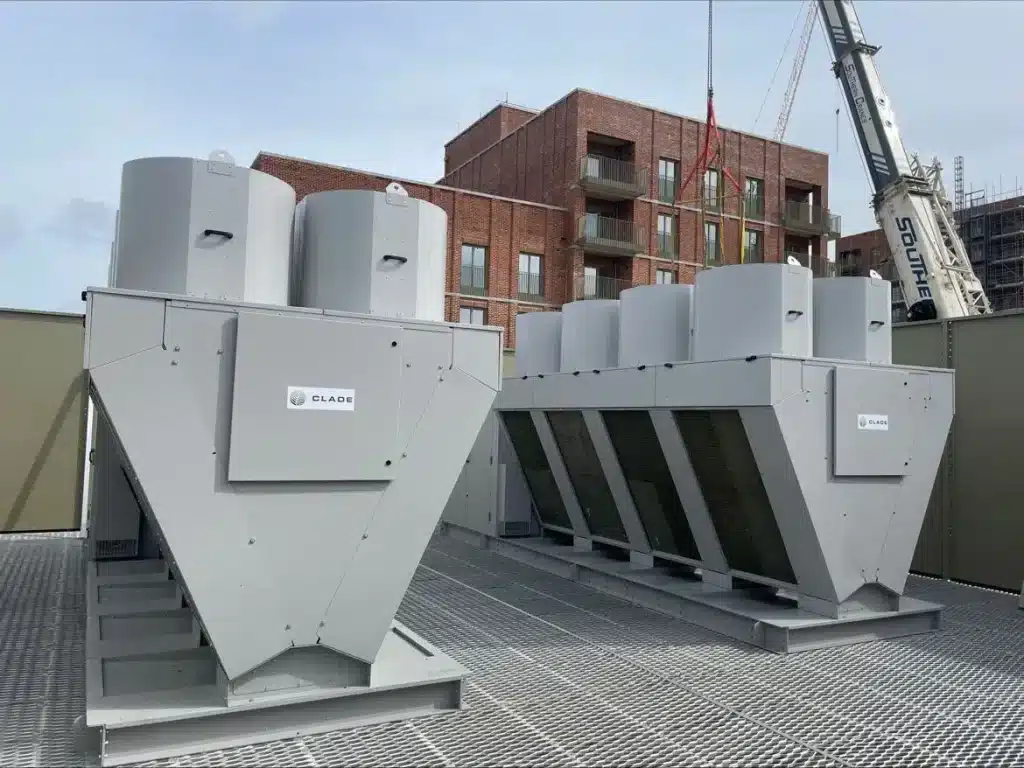
Air source heat pumps extract warmth from the air, using an extractor. This is then passed to a compressor, where the temperature and pressure are increased using a small amount of electricity.
Next, the heat energy passes to a heat exchanger, where it’s transferred to whatever you want it to warm – in this case, your mains water supply, which circulates to taps and showers.
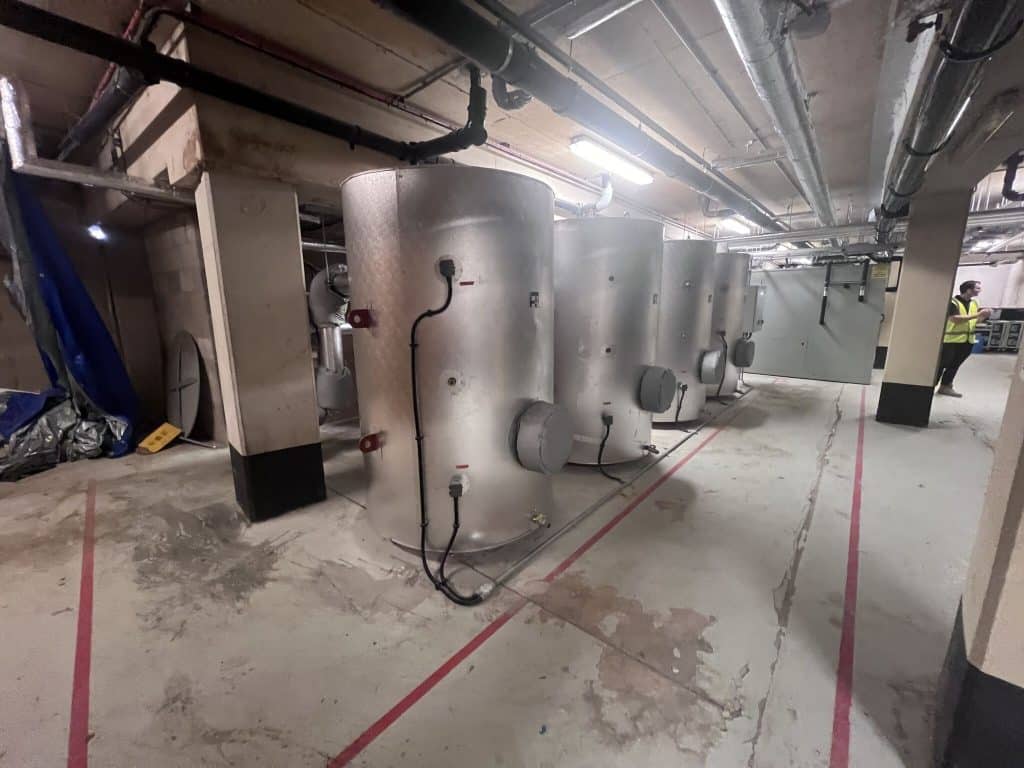
Hot water is generally stored in a hot water cylinder, where it can be sent straight to taps in the building once they’re turned on to provide instant hot water without any waiting required.
How long does a heat pump take to heat water?
It’s difficult to say exactly how long a heat pump takes to heat water, as this depends on lots of different factors. These include:
- Heat pump capacity. The higher the wattage of your heat pump, the more powerful it will be and the quicker it will heat water. However, larger heat pumps are usually paired with larger cylinders, which brings us onto…
- Cylinder size. The larger the size of your hot water cylinder, the longer it will take to heat from cold.
- Target temperature. Hot water should be stored or pasteurised at 60°C or higher to kill bacteria. The higher the target temperature, the longer it will take to heat. Instantaneous hot water can be much lower temperatures because it is not stored.
- Heat pump efficiency. More efficient heat pumps will work faster to heat water than less efficient models. Heat pump efficiency can vary based on factors like refrigerant and system design.
- Ambient temperatures. The colder the temperature of the air outside, the harder your air source heat pump will need to work to convert it to the required flow temperature, and the longer it will take.
Important: The time it takes to heat your domestic water isn’t the same as how long you have to wait once you turn the tap on.
On the contrary, DHW heat pumps are usually paired with a hot water cylinder.
Here, hot water is stored ready to be sent straight to your taps when they’re turned on.
This means you shouldn’t ever be left waiting for water to heat up, unless you use more than what’s stored in your hot water cylinder.
A good system designer should prevent this from happening by sizing your hot water cylinder correctly, ensuring that there is always more than enough to meet your needs.
Ensuring instant domestic hot water with heat pumps
Pairing a heat pump with a correctly sized hot water cylinder means you shouldn’t ever have to worry about how long it takes to heat water for your building.
This is because your hot water cylinder should always be full of hot water, ready to be sent straight to your taps when you need it.
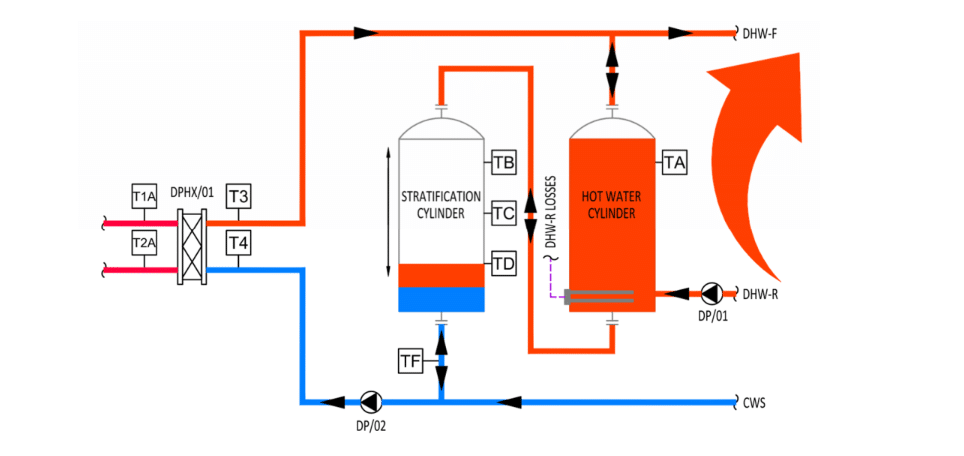
At Clade, we typically use a two-cylinder approach for domestic hot water.
One cylinder is the hot water cylinder, which is maintained hot at all times, using direct electrical immersions.
The other is known as your stratification cylinder, which is separated into layers based on temperature, with hot water at the top and cold water at the bottom.
These two cylinders are connected and work together to make sure you always have hot water available to meet your needs.
When taps are turned on in your building, hot water leaves the top of the hot water cylinder to fulfil demand.
Meanwhile, the cold return water gets fed into the bottom of the stratification cylinder. This pushes the hot water at the top of the stratification cylinder into the bottom of the hot store cylinder, so that it’s ready to go when someone turns a tap back on.
Eventually, the stratification cylinder will fill up entirely with cold return water (while the hot water cylinder remains hot) – at which point, it’s time for your heat pump to get to work and raise the temperature of the cylinder, using the plate heat exchanger.
In this way, providing your cylinders have been properly sized, you should always have a steady supply of available hot water to meet the demands of your building instantly.
Enjoy instant hot water with a Clade-designed heat pump system
At Clade, our two-cylinder system for domestic hot water is there to ensure you always have a plentiful supply of hot water when you need it.
Our system designers will take the time to understand your hot water needs and schedules to design a system that’s properly sized and set up to meet your exact requirements.
Ready to see how an air source heat pump could meet your space heating and DHW requirements far more efficiently (and sustainably!) than a gas boiler?
Just get in touch to find out more.
]]>
Heat pumps work by absorbing heat energy from the environment and compressing it into high-grade heat that can be delivered through a heating distribution system.
However, to do this, they rely on a small amount of electricity.
Here, we’ll answer all your questions about heat pump power consumption – from how much electricity a heat pump actually uses, to the factors that affect electricity usage.
How much electricity does a heat pump use?
Heat pumps use much less electrical energy than they produce in heat energy.
This is because they don’t need to work to generate heat from scratch. Instead, they simply transfer heat energy from one place to another.
In fact, just 30% of the energy used by an air source heat pump is provided by electricity. The rest is generated by the environment for free.
This means that heat pumps are extremely efficient. They typically reach around 300% efficiency compared to the most efficient gas boilers, which only reach around 98% efficiency.
Calculating air source heat pump power consumption
It’s impossible to state with certainty exactly how much electricity a heat pump uses.
After all, it’ll depend on lots of site-specific factors, like a heat pump’s size, controls, ambient temperatures, and even refrigerant.
Here are the main factors you’ll need to consider when calculating air source heat pump power consumption.
Efficiency rating
Heat pump efficiency is measured by its Coefficient of Performance (COP), which is the ratio of heating capacity and total power input.
As an example, a COP of 2.5 indicates that, at a steady rate, you generate 2.5 kW of heating capacity by using 1 kW of electric power.
At Clade, we typically see COPs between 3 and 4 in our heat pumps, although this can vary depending on factors like ambient temperatures, which brings us onto…
Ambient temperatures
The colder it is outside, the harder a heat pump will have to work to achieve the required flow temperature.
This means that heat pump power consumption will be higher on cold days and lower on warm days.
A heat pump’s Seasonal Coefficient of Performance (SCOP) is a measure that aims to take into account temperature variances across the year to give you an idea of how efficiency averages out across the seasons.
Outlet temperature
As a rough guide, the higher the outlet temperature, the more work the compressor inside the heat pump has to do to achieve the required temperature. This increases energy usage.
With this in mind, heat pumps usually use less power when they’re paired with emitters that have a larger surface area (and therefore that require a lower inlet temperature) – like underfloor heating or larger radiators.
Just bear in mind that there are exceptions. For instance, our CO2 heat pumps are actually more efficient at higher output temperatures because of the unique thermodynamic properties of CO2. Head over to our blog on high temperature heat pumps to learn more.
Heating needs
How you use your heat pump system – and what you require of it – can affect your energy usage.
As an example, you might have a big heating demand at a certain time of day.
Likewise, some buildings need a heat pump for space heating only, while others need one for both space heating and domestic hot water.
Factors like these affect what size heat pump you need and how hard your heat pump has to work to meet your needs. Which brings us onto…
Heating pump size
Your heat pump must be properly sized to your building’s heating needs.
A heat pump that’s too small will increase your electricity usage as it will run constantly, trying (and likely failing) to reach your temperature requirements.
However, a heat pump that’s too big will be no good either. This will lead to it running short cycles that risk leading to costly repairs and early replacement.
Your system designer will be able to properly size your commercial heat pump, taking into account your heating needs and other requirements.
Refrigerant
Different refrigerants have different levels of efficiency. So, your choice of heat pump refrigerant can affect your overall energy usage.
Refrigerants are largely split into two groups: synthetic (mostly F-gases) and natural.
Natural refrigerants tend to be more efficient in heat pumps as they have no glide. This is a thermodynamic behaviour found in some synthetic refrigerants.
At Clade, we only use natural refrigerants, as not only are they highly efficient, but they’re also vastly better for the environment.
Operation
How your heat pump is operated on-site will also impact your electricity consumption.
For instance, frequently adjusting thermostats, setting domestic hot water temperatures too high, or frequent stop-start cycling can all lead to inefficiencies and increased energy usage.
Maintenance
A well-maintained heat pump will be more efficient.
Regular servicing is crucial for maintaining heat pump efficiency, and therefore lowering power consumption (and energy bills!).
How to reduce your heat pump’s energy consumption
If your heat pump isn’t quite getting the COPs you expect, this could be down to a few factors:
- Differences in ambient temperature and humidity from what was designed
- Maintenance and operational factors
- Design and installation quality
While the first is to be expected to some extent (after all, COP measurements are very finely tuned and can be affected by things like sensor sensitivity), the second is something that can be honed to reduce your heat pump’s energy consumption.
Maintenance
Properly maintaining your heat pump can help you improve its efficiency and reduce your energy usage.
Light maintenance tasks that can keep your heat pump in the best condition include:
- Checking that airflow isn’t blocked by dust or debris
- Occasionally cleaning the fan blades
- Replacing filters when needed
You should also ensure that your heat pump is serviced at least once a year, ideally twice.
During a service, your engineer will assess your heat pump’s overall energy efficiency and may make adjustments to help reduce energy consumption.
Plus, they’ll be able to identify and fix any issues with your heat pump to make sure that it continues working as efficiently as possible between services.
At Clade, we offer heat pump servicing and maintenance as well as installation and design services.
Operation
How you operate your heat pump can lead to inefficiencies that can impact energy usage.
As a general guide, consistent, low-temperature settings are more efficient than frequent adjustments.
A buffer tank can also help by minimising the number of stop-start cycles.
A building management system (BMS) can monitor your heating system and flag any inefficiencies, empowering operators with clear, actionable insights so they can optimise performance.
At Clade, most of our heat pumps are also remote monitoring enabled, which means our team in Leeds can keep a close eye on how your heat pump is performing and make any necessary adjustments to improve efficiency from afar.
Air source heat pumps and electricity consumption: final thoughts
Although there are many factors that can affect air source heat pump electricity consumption, one thing’s sure: heat pumps still use very little electricity!
They’re also a lot more efficient than other heating systems like traditional boilers.
The problem lies in the current cost of electricity.
Although a heat pump can reduce your energy bills significantly, electricity is still around four times pricier than gas.
Luckily, we can expect this cost to decrease as the UK gets more and more of its electricity from renewable sources. Plus, the electrification of heat opens up the opportunity to make use of grid flexibility, which can cut your energy bills drastically.
Alternatively, you could consider pairing your commercial heat pump with a renewable energy source such as solar panels. Doing so could see you reducing your energy bills to zero.
Ultimately, switching from a boiler to a heat pump allows businesses to reduce their power consumption and, when used smartly, organisations can benefit from additional flexibility and cost savings.
Talk to us about heat pump power usage
Considering investing in a commercial heat pump? Want to understand what your power usage would look like?
Our team of experienced engineers can take the time to understand your requirements before designing a bespoke heat pump system that can heat your building as efficiently as possible.
Just get in touch with our team to start the ball rolling.
]]>
If you’re considering switching from a commercial boiler to a heat pump, you might be wondering whether a heat pump will work with radiators.
Contrary to what you might think, the answer is yes!
However, there are some emitter design considerations your system designer will need to bear in mind. Here’s the lowdown.
Do heat pumps work with radiators?
Yes, heat pumps work with radiators.
Air source heat pumps work by absorbing energy from the air and compressing it into high-grade heat, using a small amount of electricity.
Although this is different from how boilers create heat, the way they deliver this heat through your building’s heating distribution system is very much the same.
This means you can pair a heat pump with radiators or underfloor heating, and together, these will heat your building in a way that feels similar to a traditional boiler.
That said, it’s important that your radiators are correctly sized to the heat pump and its refrigerant.
This is because heat pumps are more sensitive and have a lower tolerance of poorly sized and controlled emitters than boilers do.
What radiators work best with a heat pump?
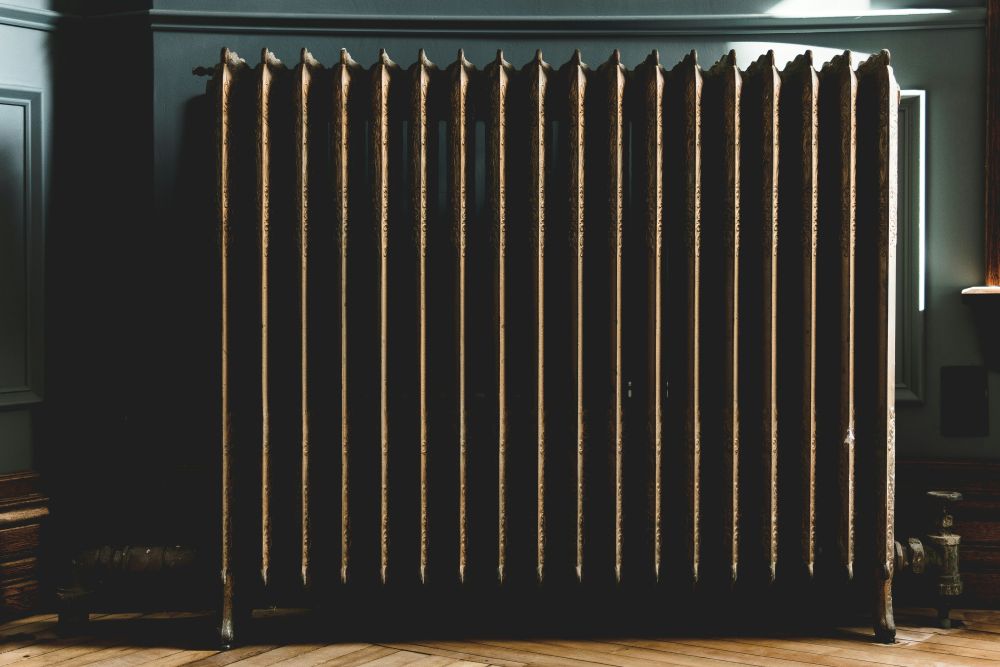
As a general rule, heat pumps work best with bigger radiators that have a larger surface area.
This is because many heat pumps operate at lower flow temperatures than traditional gas boilers. A larger surface area allows them to heat a room just as effectively while operating at a lower temperature.
With this in mind, most buildings will benefit from switching to larger radiators if they’re retrofitting a heat pump.
However, this isn’t always the case. Which brings us onto…
Will a heat pump work with my existing radiators?
While most buildings will benefit from upgrading to bigger radiators when retrofitting a heat pump, this isn’t a hard and fast rule.
Whether you can keep your existing radiators will depend on factors such as…
- The existing boiler
- The existing radiators
- The heat pump and refrigerant
In particular, many buildings in the past have been fitted with oversized radiators, meaning they’re already suitable for low flow temperatures.
Similarly, if you can’t easily make changes to your building’s existing infrastructure, your system designer may suggest a high temperature heat pump that’s designed to allow you to keep your building’s existing radiators.
Our Elm heat pump has been designed especially for this purpose, and is the UK’s first direct boiler replacement heat pump.
Radiators vs underfloor heating for air source heat pumps
Radiators and underfloor heating can both be very effective with heat pumps.
The right choice for your building will depend on lots of factors, like your budget, existing heating system, heat pump unit and refrigerant. Likewise, there will be different considerations for new builds vs retrofit projects.
Here are the pros and cons of each.
Heat pump and radiators
Radiators tend to cost less to purchase and install than underfloor heating. This is especially the case if you’re retrofitting a heat pump and you already have radiators in place.
In this case, switching your existing radiators for bigger ones (or even keeping your existing radiators if that’s an option) will cost significantly less than retrofitting underfloor heating.
It will also be less disruptive and therefore make it easier for businesses to operate continuously during the retrofitting process.
Pros
- Cheaper to buy
- Costs less to install
- Less disruptive to install
- More likely to allow for continuous operation during installation
Cons
- Less efficient than underfloor heating
- Potential for cold spots
- Takes up wall or floor space
- Less visually appealing
Heat pump and underfloor heating
Underfloor heating is a particularly efficient match for heat pumps as, just like heat pumps, it tends to operate at low flow temperatures.
This is thanks to its large surface area, which means it doesn’t need to operate at high temperatures to provide effective space heating.
It’s often a particularly attractive option for new builds, as it’s generally more cost-effective to install underfloor heating from scratch than it is to retrofit it. Plus, disruption won’t be such a big factor.
Pros
- Designed to operate at low flow temperatures
- Distributes heat evenly (no cold spots)
- Saves wall and floor space
- Out of sight
Cons
- More expensive
- More disruptive to retrofit
- Harder to ensure continuous operation during installation for retrofit projects
Let our system designers make the right choice for your building
As you can see, there are lots of considerations to take into account when you’re choosing what kind of emitters to pair with your heat pump.
However, this isn’t something that you need to worry about.
Rather, it’s your system designer’s job to recommend the best solution for your building, taking into account your site, budget, preferences and heating requirements.
At Clade, our system designers are experts in their field and can help to design the ideal heat pump system for your building, from the unit to the emitters and everything in between.
Just get in touch to get started.
]]>
There’s only one thing better than a heat pump: a heat pump paired with solar panels!
By using solar panels to power a commercial air source heat pump, sites can cut emissions, stabilise running costs, and future-proof operations even further.
Here, we’ll explore why an air source heat pump and solar panels are a match made in heaven, and how the two work together.
Solar panels and heat pumps: how they work
Solar panels work by harnessing the power of the sun to turn it into usable electricity for your building.
They do this using photovoltaic (PV) cells. When sunlight hits the cells, this generates an electrical current that can be used to turn on lights, heat water, power electric cars, and more.
Meanwhile, heat pumps work by absorbing heat energy from the environment and compressing it into high-grade heat that can be delivered through a heating distribution system, such as radiators or underfloor heating. To do this, they use a small amount of electricity.
While most heat pump systems take this electricity from the national grid, you can also generate it on-site using a renewable energy system like solar panels or wind turbines.
Why pair an air source heat pump with solar panels?
Heat pumps and solar panels are both excellent renewable energy systems in their own rights.
But by pairing them together, you can make them both more valuable.
Although heat pumps don’t use much electricity, buying electricity from the national grid is expensive.
On the other hand, generating your own electricity using solar panels means you can power your heat pump completely for free. So, the only running costs you have to contend with are servicing and maintenance.
Likewise, generating your own electricity reduces your carbon footprint even further.
Even though heat pumps are a sustainable heating system, the national grid still largely relies on fossil fuels to generate electricity (although the proportion of fossil-fuel-generated energy is reducing).
Meanwhile, using solar panels to power your heat pump can reduce your building’s emissions to zero.

What are the benefits of solar heat pump systems?
Using a heat pump to heat your commercial building comes with so many benefits, even without solar panels – from lower running costs to increased energy efficiency and lower carbon emissions.
But pairing a heat pump with solar panels adds several more advantages to the already long list:
- On-site generation is cheaper than grid power
- Even lower carbon intensity of heat
- Heat pumps can absorb all the excess electricity generated, ensuring no spill to grid at low value
- When combined with storage (thermal or batteries), even more flexibility is built into the system
- Futureproofs operations, as the system won’t be affected by regulations concerning the decarbonisation of heating
- Financing is available to cover both heat pumps and solar PV for a one-stop shop
What are the disadvantages of solar energy heat pump systems?
The main disadvantage of combining a heat pump and solar panels is cost – both heat pumps and solar panels require a significant upfront investment.
Luckily, there are schemes, tax breaks, and financing options available to help encourage businesses to adopt renewable energy systems like these – including our finance offering that can cover both heat pumps and solar panels for a one-stop shop.
Another potential disadvantage is that, while solar panels can generate electricity year-round, they can’t generate electricity when there’s no sunlight – for instance, in the dark or on very cloudy days.
This means that, without storage, you’d end up sending any excess electricity back to the grid on sunny days, and then drawing from the national grid to power your heat pump when sunlight is harder to find.
In other words, if you want to be able to power your heat pump solely through solar energy, the right storage is a must. Which brings us onto…
The importance of storage for heat pump and solar panel combinations
Without storage, businesses will be left relying on the national grid to power their heat pump during hours of darkness or on particularly cloudy days.
However, storage in the form of batteries or thermal storage can be a game-changer, allowing businesses to power their heat pump purely using solar energy.
With batteries, excess energy generated on sunny days can be used to charge a battery instead of being sent back to the grid, for use later down the line when the sun is playing hard to get.
Likewise, with thermal storage, excess electricity can be absorbed by your heat pump and used to heat water which is then stored in a buffer tank, ready to warm up your building at another time.
In this way, you get maximum flexibility. You can…
- Use the electricity generated to heat your building when you want
- Avoid spill to the grid at low value
- Keep your energy savings high
- Reduce your reliance on the national grid

Tackling the cost of a heat pump with solar panels
The cost of combining a heat pump and solar panels can vary widely depending on the needs of each business.
Factors include things like:
- The size of your business premises
- How well your building is insulated
- System power and efficiency
- Required room temperature
- Whether you use a heat pump for hot water, space heating, or both
- Whether you’re retrofitting the system or incorporating it in a new build
However, there’s no denying that heat pumps and solar panels both require a significant upfront investment – especially when the two are combined!
The good news is that there is financial support available.
In Scotland, small and medium-sized enterprises (SMEs) can apply for an SME loan of up to £100k to help pay for energy and carbon-saving upgrades.
If you’re eligible, you could also receive a cashback grant of up to £30,000 to help towards your costs.
Other incentives available to UK organisations include the Social Housing Decarbonisation Fund (SHDF) and tax breaks under the HMT expensing policy.
At Clade, we’re also proud to be able to help businesses spread out the upfront cost of both heat pumps and solar panels with commercial heat pump financing.
Either way, it’s important to factor in not just upfront costs but also running costs when you’re budgeting for these systems.
Not only are heat pumps much more efficient than traditional boilers, but when combined with solar panels, businesses can generate the electricity needed to power their system completely for free!
This means businesses can expect to make back their initial upfront investment costs in the long term.

Let’s talk about air source heat pumps and solar panels
Keen to explore a heat pump and solar panel pairing to heat your business premises?
You’re in the right place!
At Clade, we have over 35 years of experience working with natural refrigerant heat pump and refrigeration systems, and have recently installed several heat pump systems powered by solar PV.
Just get in touch to learn more and start the ball rolling.
]]>
Heat pumps harness heat energy from the environment to keep buildings warm.
But what happens when temperatures drop over winter?
Luckily, heat pumps can reliably provide space heating and hot water, even in temperatures below freezing.
Here, we’ll delve into the details of how effective heat pumps can be in winter – from how they work in cold weather to how we can measure heat pump efficiency in low temperatures.
Do heat pumps actually work in cold weather?
Yes! It’s a common misconception that heat pumps aren’t effective in cold weather. But this isn’t true at all.
Rather, heat pumps have been proven to work reliably even in the coldest parts of Scandinavia, where temperatures regularly drop well below freezing.
Most heat pumps are able to work reliably in ambient temperatures as low as -10°C. But many can work as low as -25°C.
At Clade, our CO2 air source heat pumps are particularly skilled at operating in very low ambient temperatures. This is because CO2 works at a higher pressure than other refrigerants, so the compressor envelopes are much wider.
However, whether a heat pump will work efficiently for your building in cold weather isn’t something you should have to worry about. Instead, that’s your system designer’s job.
Your system designer will look at details like your heating requirements, ambient temperatures and more, before selecting the right heat pump unit and designing a bespoke system that can provide you with a consistent indoor temperature throughout the year, regardless of what’s going on outdoors.
How does a heat pump work in winter?
Air source heat pumps are designed in such a way that it doesn’t actually need to be warm outside for them to be able to extract warmth from the air.
The evaporator works to absorb the smallest amounts of heat energy in the air outside, even when it doesn’t feel warm.
This is compressed into high-grade heat by the compressor using a small amount of electricity. Then, the heat is delivered through a heating distribution system like radiators or underfloor heating in a way that feels similar to a traditional boiler.
Of course, the heat pump has to work a little harder when it’s cold outside compared to when it’s warm.
But because the heat pump isn’t generating heat from scratch – rather, it’s just transferring it from one place to another – it still uses less electricity than the heat it generates, making it an efficient method of heating.
Which brings us onto…
How efficient are heat pumps in cold weather?
Heat pumps fluctuate in efficiency throughout the year based on ambient temperatures.
Essentially, as the temperature of the air outside decreases, a heat pump’s efficiency will also decrease, as the compressor inside the heat pump will need to work harder to reach the desired flow temperature.
However, heat pumps are still a lot more efficient than your average gas boiler!
While the most efficient boilers can reach around 98% efficiency, air source heat pumps typically range between 200% and 400% efficiency, depending on ambient temperatures.
With that in mind, even in temperatures below freezing, they can often still be twice as efficient as other heating sources!
How to measure heat pump efficiency in winter
Heat pump efficiency is measured by its coefficient of performance (COP), which is the ratio of heating capacity and total power input.
The higher the COP, the more efficient the heat pump.
As a rough guide, air source heat pumps can reach COPs of 4 or even higher in warm ambient temperatures. Meanwhile, in temperatures below freezing, this might drop to 2 or lower.
A COP of 2 indicates that, at a steady rate, you’ll generate 2 kW of heating capacity by using 1 kW of electric power (assuming the heat pump is driven by an electric motor, which is usually the case).
In other words, a heat pump with this COP will still be 200% efficient, which is a lot more efficient than the best gas boilers.
That said, looking at a heat pump’s efficiency in winter alone won’t give you the full picture.
Instead, looking at a heat pump’s SCOP (seasonal coefficient of performance) will show you how your heat pump’s efficiency can be expected to average out over a full year.
It does this by summing up the heat that is generated per year and dividing it by the total electric energy use. For air source heat pumps, this is calculated by dividing the total ambient temperature range into sub-intervals and defining the duration of each.
Heat pumps should generally be expected to generate SCOPs of 2.5 or higher – meaning a year-round efficiency of 250%.
Do heat pumps freeze in cold weather?
Yes, in cold and humid weather, frost and ice can build up on your heat pump’s evaporator coils.
But this isn’t the problem you might think it is.
Modern heat pumps automatically enter a defrost cycle when this occurs, which allows them to melt the ice and continue working efficiently.
At Clade, we’re a step ahead of our competitors in the way our heat pumps defrost.
Essentially, most heat pump manufacturers use a method called reverse cycle. This involves the heat pump working in reverse and using heat that’s stored in the buffer vessel to defrost the coils – which actually takes useful heat away from your building.
On the other hand, Clade heat pumps use hot gas defrost. This is where hot refrigerant from the heat pump is put through the evaporator to defrost coils.
The big benefit here is that all the heat from your buffer vessel can be used for heating rather than defrosting, making for a more efficient system.
Plus, your building can continue to receive heat while your heat pump defrosts (as long as you’re storing enough thermal energy in your buffer to cover those defrost periods) – unlike units that use the reverse cycle method.
How to maximise heat pump efficiency in winter
There are lots of factors that go into determining the efficiency of a heat pump – from system design to the refrigerant it uses and, of course, ambient temperatures.
However, once your system has been designed and installed, its efficiency isn’t completely out of your control.
Here are two simple steps you can take to boost your heat pump’s efficiency during those cold winter months.
1. Maintenance
Properly maintaining your heat pump will help to ensure it’s working efficiently, whatever the weather.
You can keep your air source heat pump in the best condition possible by:
- Regularly checking that airflow isn’t blocked by dust or debris
- Occasionally cleaning the fan blades
- Replacing filters when needed
Most commercial heat pumps should also be serviced at least once a year and ideally twice.
During a service, the Clade aftercare team will identify and fix any issues with your heat pump that are causing it to work less efficiently – from refrigerant leaks to wear and tear or damage to components.
They can also assess your heat pump’s overall energy efficiency and may make adjustments to help reduce energy consumption.
2. Smart scheduling
How you use your heat pump system – and what you require of it – can affect your COPs.
For instance, if there’s a big heating demand at a certain time of day, this can mean your heat pump needs to work very hard for just a short window.
However, smart scheduling can help to lessen the load, especially with the right-sized thermal store.
At Clade, most of our heat pumps are also compatible with remote monitoring. This means that the Clade team can monitor your heat pump from our base in Leeds and make adjustments to ensure that it’s always operating as optimally as possible.
Is a heat pump worth it in cold weather?
Yes, a heat pump is absolutely worth it in cold weather.
Not only can a heat pump work efficiently in low temperatures, but when you average out performance across the year, its efficiency is unrivalled.
Plus, heat pumps come with a whole host of other benefits, including:
- Low energy bills
- Reliable
- Eco-friendly
- Won’t become a stranded asset (especially in the case of natural refrigerant heat pumps, which don’t contain harmful F-gases)
- Easy to control
Early adopters of heat pumps may also find that the switch helps them boost their brand reputation. After all, opting for renewables can be a great demonstration of a company’s values and care for the environment.
Talk to us about whether a heat pump could work for your business
Contrary to what you might think, heat pumps can be a good fit for most buildings and most climates.
If you want to find out whether a heat pump could work efficiently for your business, the answer is probably yes – but our expert team of system designers can tell you for sure by taking the time to learn more about your premises and heating needs, before designing a bespoke heat pump system that’s tailored to your needs.
So, what are you waiting for? Simply get in touch with us today to start the ball rolling.
]]>
Heat pumps are transforming how UK buildings stay warm, efficient, sustainable, and ready for the net-zero future. But one question comes up in almost every installation conversation:
“Will my existing radiators and heat emitters work with a heat pump?”
The short answer is sometimes. But in commercial settings, achieving the correct emitter capacity is essential for meeting heating demand at low flow temperatures and unlocking high system efficiency.
In this guide, we’ll explain how heat pumps and radiators work together, how to know if your current setup is compatible, and how to figure out exactly what size radiators your building needs.
Why Radiator Size Matters for Heat Pumps
Traditional gas or oil boilers heat water to high temperatures, typically around 70–80°C, before pumping it through your radiators. Modern condensing boilers operate at lower flow temperatures as required under various rules, typically about 55°C. This means there are a lot of different variations of emitter size out there in the UK’s building stock.
Heat pumps, on the other hand, work differently. They use electricity to extract heat from the air or ground and deliver it into your building at a lower flow temperature, usually between 35°C and 55°C. Some heat pumps, like our Elm and Yew, can match traditional boiler temperatures but are still more efficient at low flow temperatures.
However, it’s not only the flow temperature that matters. The temperature differential (ΔT) between flow and return sets the mean water temperature (MWT) through the radiator, and this is what determines emitter output and required radiator size.
Mean Water Temperature, ΔT, and Radiator Output
Radiator output depends on the temperature difference between the mean water temperature and the room temperature.
A smaller ΔT at a given flow temperature results in a higher mean water temperature, which increases radiator output and allows smaller emitters. A larger ΔT lowers the mean water temperature, which reduces radiator output and requires larger emitters.
For example:
- A CO₂ heat pump operating at 70°C flow and 30°C return has a mean water temperature of 50°C.
- An R290 heat pump operating at 55°C flow and 45°C return also has a mean water temperature of 50°C.
In this case, both systems would require the same size radiator, because the mean water temperature, and therefore the radiator-to-room temperature difference, is the same.
By contrast, if the flow temperature is held constant:
- 55°C flow with a 5°C ΔT gives an MWT of 52.5°C
- 55°C flow with a 10°C ΔT gives an MWT of 50°C
The larger ΔT reduces the mean water temperature, which would require larger emitters to achieve the same heat output.
This is why ΔT should never be considered in isolation. Emitter sizing must always be based on mean water temperature, not flow temperature alone.
It’s also worth noting that a larger ΔT mainly benefits system hydraulics, which enables reduced flow rates, smaller pipework, and lower pumping energy, rather than reducing emitter size.
How to Work Out Radiator Size in Commercial Buildings
The good news is that many modern radiators are already suitable for heat pump systems, especially if a building is well insulated. Here’s how to get a sense of whether yours will be up to the job:
1. Calculate the heat loss of each zone
This determines the wattage the radiator must deliver.
Heat loss depends on a number of factors, which all engineers should be familiar with. The more detailed the calculation, the more accurate the outcome; equally, the more estimates and assumptions that are used, the less reliable the number.
2. Look at the required flow temperature
Often:
- R290 systems operate around 45–65°C, or high-temperature options at 70–80°C, with a 5–20°C ΔT
- CO₂ systems can deliver up to 80°C with a high ΔT
Emitter output at 80°C is vastly different from output at 45°C, so a radiator heat output chart should always be used to match the actual operating conditions.
Radiators are rated at a ΔT, which is the difference between the mean water temperature and the room temperature. Common reference points include ΔT50 and ΔT20, with manufacturers able to provide correction factors where required.
In many commercial buildings, with the right heat pump and the correct combination of flow temperature and ΔT, no emitter changes are needed. This can result in significant installation cost savings, although it may lead to a lower SCOP. The customer and designer need to find the right balance.
The Best Radiators for Heat Pumps (Commercial)
Here’s how the main emitter types compare in real commercial environments.
Steel Panel Emitters
These are the most common in commercial buildings.
- Higher surface area due to multiple panels and convector fins
- Strong performance at ΔT30–ΔT20
- Good output-to-size ratio, ideal for offices, corridors, classrooms, and mixed-use spaces
- Easy to source and install, with predictable performance data across manufacturers
In many retrofit projects, replacing these is relatively straightforward.
Fan-Assisted Radiators / Low-Temperature Convectors
A smart choice where wall space is limited, or heat loss is higher than standard radiators can cover.
- Integrated fans help maintain high heat output even at very low water temperatures
- Ideal for legacy buildings, public sector estates, schools, and large open-plan areas
- Fans allow rapid response to changing loads, helping heat pumps avoid cycling
- Often used to avoid oversizing radiators when aesthetics or space are a constraint
These are a favourite in commercial retrofits where ΔT20–ΔT25 systems need extra output without upsizing pipework dramatically.
Fan Coil Units (FCUs)
Many commercial buildings already use FCUs, making heat pump integration simpler than expected.
- Designed for variable flow temperatures
- Provide forced convection, meaning strong output at ΔT30 or lower
- Often only need minor adjustments (e.g., coil cleaning, valve updates, or flow balancing)
- Work well with R290 and CO₂ heat pump systems, depending on building demand
For offices, retail units, universities, and mixed-use buildings, FCUs can often remain unchanged during a heat pump retrofit.
Talk To Us About System and Emitter Design
Getting radiator design right is one of the most important steps in a successful heat pump installation.
From heat loss calculations and emitter selection to system balancing and commissioning, every detail affects performance, comfort, and long-term efficiency.
That’s where we can help.
At Clade, our engineers design, manufacture, and support complete natural-refrigerant heat pump systems to ensure that radiators, controls, and flow temperatures all work together seamlessly.
Just get in touch to discuss your project or learn how we can help you design the right radiator setup for your heat pump system.
]]>
Refrigerant policy in the UK and Europe is tightening. As high-GWP F-gases are phased down, chemical manufacturers are introducing new ‘lower-GWP’ synthetic blends, most notably the ‘R454’ family (R454A, R454B, R454C).
These refrigerants are being marketed as necessary transitional solutions for commercial heat pumps and air-conditioning systems at a time of regulatory change.
But it begs the question as to what role these blends play, why they were created, and whether they offer any meaningful engineering or environmental advantage.
Why R454 Blends Were Developed
R454-series refrigerants were not designed to deliver breakthroughs in performance or safety. They were formulated to sit marginally below key regulatory thresholds, particularly Global Warming Potential (GWP) limits. This enables manufacturers to continue selling fluorinated gases while appearing aligned with phase-down policy.
For example:
- R454C has a GWP of about 145-148, placing it just below the 150 GWP threshold used in EU F-gas regulation for certain applications.
- R454B has a GWP of around 465-466, which is well above thresholds for genuinely low-impact refrigerants.
All three R454 blends rely on existing fluorocarbons R32 and R1234yf, recombined in differing ratios to form ‘new’ products without solving any underlying engineering challenges.
This is regulatory compliance by design, rather than innovation. Natural refrigerants such as R290 and CO₂, already achieve near-zero GWP and comply with long-term policy expectations without compromise.
Technical Performance
The primary appeal of R454 blends is familiarity.
Equipment using R454 often resembles traditional F-gas systems, making adoption straightforward for supply chains accustomed to legacy refrigerants. However, familiarity is not the same as technical merit.
The thermodynamic performance of R454 blends does not exceed that of natural refrigerants. They introduce no properties that meaningfully improve heat pump performance, efficiency, reliability, or resilience. Their behaviour in real-world operation aligns closely with existing F-gas blends, with similar limitations and no evidence of superior outcomes.
Manufacturers can produce data curves and tests that appear favourable, but these scenarios are selectively constructed and rarely reflect typical operating environments. In practice, R454 blends are neither more efficient nor more capable than established natural alternatives.
Flammability Without Environmental Benefit
The R454 series sits in the A2L classification: lower flammability refrigerants.
This categorisation is often used to suggest a safety advantage over hydrocarbons. However, many newer A2L blends are still mildly flammable because they remove high-GWP fire-suppressant components like R125, and rely instead on flammable constituents such as R32 and R1234yf to reduce overall GWP.
The result is a refrigerant that is:
- Still flammable
- No safer than hydrocarbons
- Significantly higher in GWP
- Unable to match the environmental performance of natural refrigerants
In other words, the R454 series provides the disadvantages associated with flammability without the environmental advantages that make flammable refrigerants worthwhile.
The engineering community already has clear design frameworks for managing flammability safely. Removing the high-GWP suppressant from synthetic blends simply shifts risk without delivering environmental benefit.
Long-Term Regulatory and Commercial Risk
The most significant commercial issue surrounding R454 series refrigerants is regulatory uncertainty.
Both the UK and EU are in the process of tightening F-gas regulations further, and the timelines for phase-down are expected to accelerate. The UK’s proposed schedules are likely to align more closely with the EU’s evolving framework.
This poses substantial challenges for any equipment designed around synthetic refrigerants:
Future Availability
As phase-down progresses, production quotas shrink and manufacturers reduce output. Historically, this has resulted in dramatic price inflation and inconsistent supply for affected refrigerants.
The same pattern is expected for R454 blends.
Long-Term Serviceability
Heat pumps typically have a 15-20-year service life. If a refrigerant becomes scarce or prohibitively expensive within that period, owners face significant operational and financial disruption.
The likelihood of a suitable ‘drop-in’ replacement refrigerant diminishes with each tightening of regulations.
Component Restrictions
Because R454 blends rely on multiple substances (R32 and R1234yf), any tightening of regulations affecting either component can undermine the viability of the entire blend.
Disposal and Recovery
Synthetic refrigerants require specialised disposal processes with associated carbon and financial costs. These impacts are not reflected in GWP figures and are borne by contractors and building owners at end-of-life.
Natural refrigerants carry none of these long-term risks. Their regulatory position is secure, and their availability is not dependent on quota systems or chemical-industry lobbying.
Environmental Impact Beyond GWP Labels
Promotional material for R454 blends often highlights that refrigerants have ‘no environmental impact while contained within a system.’ This is misleading.
All commercial refrigeration and HVAC systems are expected to leak over their lifetime and leak checking only detects issues that have already occurred – a leak has to already be happening for it to be found.
Even small losses contribute to climate impact when a refrigerant has a GWP tens or hundreds of times greater than natural alternatives.
Additional environmental considerations include:
- Fugitive emissions during production (which are permissible within manufacturing standards but not reflected in published GWP values)
- Emissions associated with recovery and high-temperature destruction
- The cumulative footprint across thousands of installed systems, particularly in AC where maintenance tends to be minimal
Natural refrigerants dramatically reduce these hidden impacts, because their GWP is near zero and they are typically produced and handled within existing industrial supply chains.
Lifecycle Cost Considerations
The whole-life cost of systems charged with R454 refrigerants is likely to exceed that of systems using natural refrigerants.
Key factors include:
- Higher initial refrigerant cost
- Volatility of future pricing due to phase-down quotas
- Potential early obsolescence if regulatory timelines accelerate
- Increased risk of significant service costs in later years of operation
By contrast, R290 and CO₂ are widely available, stable in price, and unaffected by synthetic refrigerant phase-down policy.
Engineering Advantages of Natural Refrigerants
Natural refrigerants already provide the performance, environmental integrity, and resilience required for the long-term decarbonisation of heat.
Efficiency
Hydrocarbons and CO₂ deliver strong thermodynamic performance, particularly for high-temperature hot water systems where large temperature differentials support efficiency.
Environmental Stability
With GWPs close to zero, natural refrigerants exceed regulatory expectations without compromise.
Futureproofing
Natural refrigerants are not subject to F-gas phase-down schedules or GWP-based bans, and they are not dependent on proprietary chemical production. That makes them one of the most future-resilient refrigerant choices available for commercial heating equipment.
Safety Engineering
The standards for safe use of flammable or high-pressure natural refrigerants are well-established, tested, and robust. Safety is achieved through engineering, not chemistry.
Whole-Life Cost
Predictable pricing, regulatory certainty, and high efficiency contribute to a significantly lower total cost of ownership compared to synthetic blends.
Talk to Us About Refrigerant Strategy and Futureproof System Design
Choosing the right refrigerant is a strategic decision that shapes efficiency, compliance, and operational resilience for decades. Blends like the R454 series may appear convenient today, but their long-term risks, regulatory uncertainty, and environmental impact often outweigh any short-term familiarity.
If you’re reviewing your refrigerant strategy or planning a heating upgrade, our team can help you make informed, futureproof decisions with total confidence.
Just get in touch to discuss your project or explore how natural refrigerants can support your long-term decarbonisation goals.
]]>
With all the hype surrounding eco-friendly heating systems like heat pumps, you’d be forgiven for wondering “…but are air source heat pumps really any good?”
And while we don’t blame you for asking, the answer is an unequivocal yes!
Although they can be expensive to install, air source heat pumps will certainly pull their weight – helping your business to benefit from increased efficiency, lower energy bills, a long lifespan and (of course!) a reduced carbon footprint.
Plus, at Clade, we’re experts at designing bespoke heat pump systems that are made to help your business reach its goals – so you can be sure you’re making the right call for your organisation.
Here’s the full picture.
Why heat pumps really are as good as they sound
Sometimes, things sound too good to be true. But in the case of air source heat pumps, they really are as good as they seem.
Here are the main benefits.
Efficient
Air source heat pumps are incredibly efficient. In fact, they’re around three or four times more efficient than your average gas boiler!
While the most efficient gas boilers can only reach around 98% efficiency, air source heat pumps are around 300% efficient.
This is because they don’t actually create heat from scratch. Instead, they transfer it from one place to another, using just a small amount of electricity. Which brings us onto…
Reduced energy bills
Just 25% of the energy used by an air source heat pump is typically provided by electricity. The rest is generated for free by the environment through the air, allowing businesses to keep their running costs down.
Using electricity to power your heating system also opens up the opportunity to use power at times when it’s cheap, known as grid flexibility.
Businesses can maximise this opportunity by oversizing their thermal store, which can cut utility costs by up to 20%.
Futureproof
Slowly but surely, decarbonisation of heating is moving up the government’s priority list.
If you’re due an upgrade to your heating system, investing in a carbon-free option makes sense and protects your new asset from becoming stranded in the future.
Just be aware that most heat pumps manufactured today still contain harmful F-gases like HFCs and HFOs – the use of which is likely to become increasingly restricted as time goes on. Already, HFCs are being phased out and HFOs are the subject of litigation.
That’s just one reason why, at Clade, we only manufacture natural refrigerant heat pumps. These won’t contribute to climate change and will therefore allow businesses to safeguard their heat pump’s longevity long into the future.
Reliable
A common misconception of heat pumps is that they won’t work in cold weather. But this is far from the truth.
Air source heat pumps are able to maintain consistent indoor temperatures throughout the year, regardless of variable ambient conditions. They’ve even been proven to work reliably in the coldest parts of Scandinavia, where temperatures regularly drop well below freezing.
At Clade, our CO2 heat pumps and R290 propane heat pumps are particularly well-suited to operating at low ambient temperatures. This is because we design them for full operation in cold conditions. That is when you need them most!
Versatile
You might think that air source heat pumps are only suited to new builds, but that isn’t the case at all. Rather, heat pumps can be retrofitted in most buildings.
Not only that, but heat pumps can be a good solution for domestic hot water (DHW) as well as space heating.
With this in mind, they’re a great fit for lots of different settings and heating needs. At Clade, we’ve supplied heat pumps to all sorts of organisations, ranging from schools to libraries, offices and even swimming pools.
Easy to control
Heat pumps are easy to use and can integrate with a range of controls, including as part of a wider climate-controlled system.
The majority of Clade heat pumps are also remote monitoring and smart-enabled.
This means our experts can monitor your heat pump’s performance remotely from our headquarters in Leeds and make any necessary adjustments. So, you can be confident that your heat pump is working as well as it should be at all times.

Eco-friendly
Last (but certainly not least!), heat pumps are an eco-friendly heating method that doesn’t produce emissions – therefore allowing businesses to reduce their carbon footprint.
It’s true that much of the UK’s electricity is still generated by fossil fuels. However, the proportion of renewable energy supplied to the National Grid is increasing.
Plus, businesses can choose to reduce their carbon footprint even more by pairing their heat pump with a renewable energy source such as solar power.
It’s also worth noting that being an early adopter of heat pump technology can help businesses reassure clients of their commitment to the environment. In this way, it can become a powerful marketing tool.
What’s not so good about air source heat pumps
We think we’ve established that air source heat pumps are indeed as good as they sound.
But like anything, there are a few downsides that it’s important to be aware of if you’re weighing up whether to make the switch from a boiler.
Upfront cost
Firstly, an air source heat pump requires a significant upfront investment.
It’s hard to put a figure on the cost of an air source heat pump, as this can vary widely depending on each business and its heating needs. However, The Guardian estimates that a heat pump currently costs four or five times more than a gas boiler for supply and installation.
Luckily, there are some financial incentives available to encourage organisations to make the switch – such as tax breaks under the HMT expensing policy.
At Clade, we also allow most businesses to spread out the initial cost of an air source heat pump with commercial heat pump financing.
Upgrades
Most buildings (but not all) will require some upgrades to maximise the potential of a new heat pump system. This can include upgrading emitters, pipework or insulation.
However, choosing a refrigerant with a similar temperature differential (or Delta T) to those used by traditional boilers – like the natural refrigerant R290 (propane) – can help to minimise the number of changes that you need to make to your building’s existing infrastructure.
And even if it isn’t possible to make upgrades to your building, you may still be able to benefit from a heat pump. Our new Elm heat pump acts as a direct boiler replacement and is designed especially for buildings where the existing infrastructure can’t be easily amended.
Less familiar
Heat pumps are still a relatively new technology and are an unknown territory for most people.
This means they can take a bit of getting used to, and there can also be an element of fear to overcome.
Having said that, they’re really easy to use and control. So, once your team gets past that initial hurdle, they won’t look back.
At Clade, our team of experts is also on hand to make the transition as seamless and worry-free as possible. We can even provide training to help your team understand how to use your business’ new heating system.

Is an air source heat pump right for my business?
While an air source heat pump might not be the perfect fit for every business, it’s a fantastic solution for the majority of buildings in the UK.
Heat pumps are a lot easier to retrofit than you might think, and can help to fulfil a wide range of commercial and industrial heating requirements – from space heating and DHW to process heat.
While the pros of heat pumps are many, there are only a few cons – the biggest of which is undoubtedly the upfront cost.
However, with help available in the form of tax breaks, occasional grants, and our own Heat-as-a-Service finance offering, air source heat pumps are within reach for more businesses than ever before.
And with their low running costs and unrivalled efficiency, it won’t be long before adopters of heat pump technology can make back their investment in energy bill savings.
If you’re still unsure whether a heat pump is the right route for your business, don’t hesitate to get in touch with our team of experts, who’ll be happy to scope out your premises and offer you their insights.
Talk to us about an air source heat pump
At Clade, we have over 35 years of experience manufacturing, designing, installing and maintaining natural refrigerant heat pumps and refrigeration systems. So, we really know our stuff.
In fact, we pride ourselves on being at the front of the curve when it comes to heat pump innovation, which can be evidenced by the fact that we were one of the first suppliers of commercial R290 heat pumps!
All this to say that if you’re umming and ahhing about an air source heat pump for your business, you’re in the right place. Just get in touch to discuss your unique requirements and get the ball rolling.
]]>