How Clade’s hot gas defrost technology affects buffer tank design
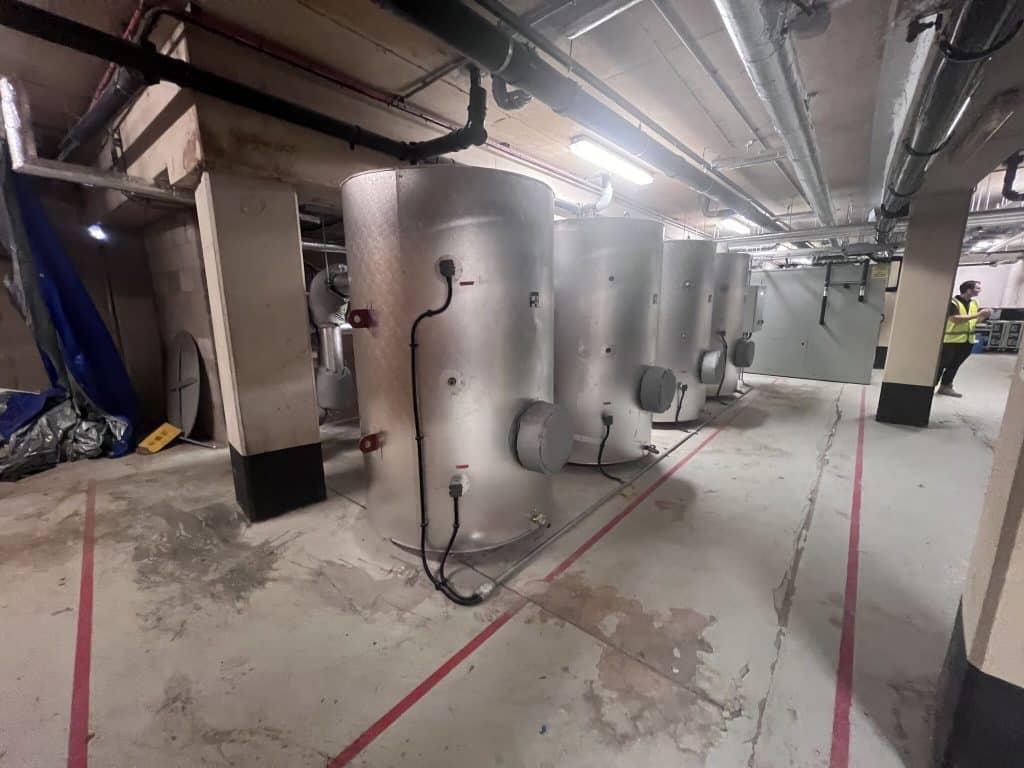
Most commercial heat pumps require a minimum buffer volume to support reverse-cycle defrost.
But Clade heat pumps use hot gas defrost, removing this requirement and allowing designers greater flexibility when sizing buffer vessels.
Here, we’ll share why we believe hot gas defrost is beneficial for heat pump systems, and offer buffer vessel specification recommendations for the commercial heat pumps we manufacture here at Clade.
The benefits of hot gas defrost
When ambient conditions are low, heat pumps need a way to defrost the frost that builds up on their evaporator coils.
At Clade, we’ve chosen to use hot gas defrost to achieve this, meaning hot refrigerant from the heat pump is put through the evaporator.
It’s more technically difficult to achieve than reverse cycle defrost, but it has several advantages:
Smaller buffer
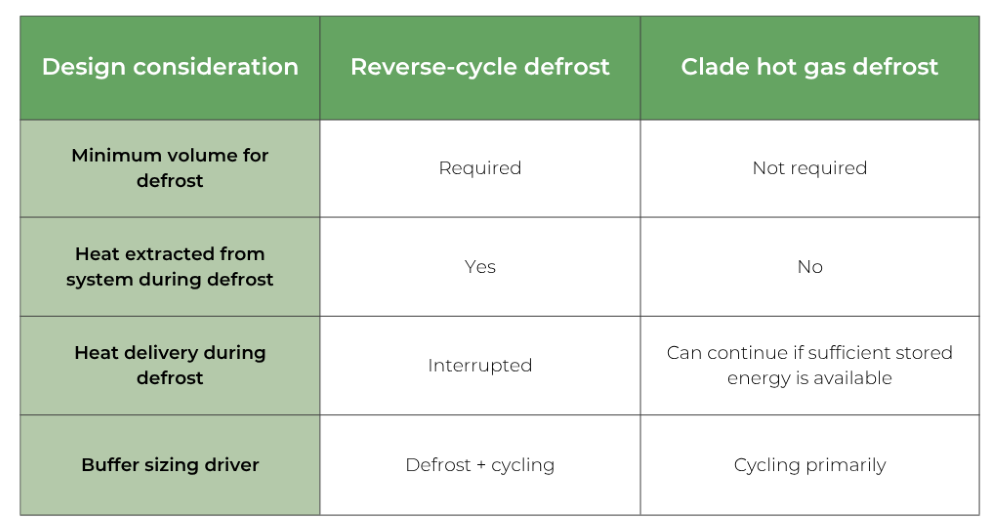
Because we don’t use the reverse cycle defrost method, this means that Clade heat pumps don’t require a buffer for defrost purposes.
Although a buffer is still recommended in most cases to protect the heat pump’s compressor, the minimum volume required for this is usually much lower.
That means you can typically get away with a smaller buffer, saving both money and space.
More efficient
Hot gas defrost is more efficient, as it doesn’t involve extracting heat from the system to defrost.
Instead, all the energy that’s been given to the building remains in the building.
No gaps in operation
With reverse-cycle defrost, the building can’t receive heat until the process is complete.
On the other hand, with hot gas defrost, the building can continue to receive heat while your heat pump defrosts – as long as you’re storing enough thermal energy in your buffer to cover those defrost periods.
Do Clade heat pumps still need a buffer tank?
At Clade, we’re one of the only manufacturers of heat pumps that doesn’t require a buffer tank for defrost.
However, we would still recommend buffers for our heat pumps in most cases.
This is because, even though our heat pumps don’t require buffers to defrost, a buffer will still help to protect your heat pump’s compressor by minimising stop-start cycles (and, of course, it can also act as useful thermal storage!).
Ultimately though, it’s up to the designer or consultant on each project to decide whether they want to protect their unit as we suggest – meaning a buffer isn’t essential in the same way as it would be for our competitors.
It’s rare, but we have seen projects in the past where a buffer hasn’t been necessary as a heat pump has been designed to run against a constant load. For instance, in one project, our Acer heat pump fed directly into a swimming pool heat exchanger.
At the end of the day, every project is different!
Buffer tank sizing considerations
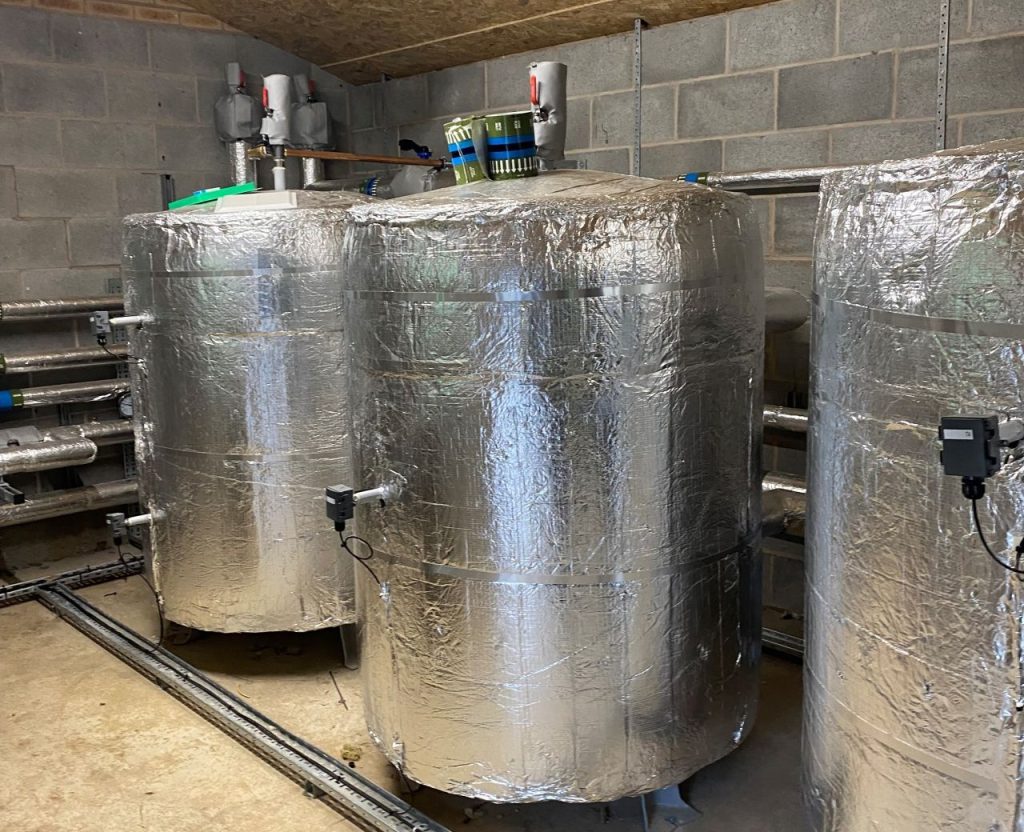
At Clade, our minimum volume requirements are typically very low as they don’t include a minimum volume for defrost.
Instead, our minimum volume is the volume of water that allows the compressor to start up safely.
That said, we also recommend using around 20 minutes of storage to cover the period when your heat pump is defrosting.
This will allow you to heat your building using your buffer while your heat pump is effectively not in action, for around 30 minutes.
Other considerations for buffer sizing include:
- Load profile – peak heat loss vs peak demand
- Grid flexibility – using a buffer for thermal storage can allow an opportunity to take advantage of cheaper nighttime tariffs
- Location – ceiling height and installation constraints may restrict buffer size
- Number of vessels – using multiple vessels can solve space restraints and reduce the portion of unusable water being stored
- Refrigerant – the smaller the Delta T, the larger your buffer vessel will typically need to be
At Clade, we use the natural refrigerants CO2 and propane. Buffer tanks for CO2 systems are typically several times smaller than those for propane systems, as CO2 has a much larger Delta T (up to around 40 degrees, compared to around 10 to 15 degrees).
Clade buffer vessel specification recommendations
If you’re using natural refrigerants, the design and specification of a buffer vessel is very important. After all, natural refrigerants – particularly CO2 – tend to have a wide Delta T.
With that in mind, here are some points that are really important if you’re looking for a buffer vessel for a Clade heat pump.
1. Height to width ratio
In Clade systems, we recommend a tall, skinny buffer vessel – which translates to a height-to-width ratio of at least 2.5 to 1.
This allows the stratification of water (from hot at the top to cold at the bottom) to be maintained, which is important for our control of a heat pump.
If you have a wider, fatter buffer vessel, this can cause those thermal layers to be less defined.
2. Sparge pipes
In Clade systems, buffer vessels should incorporate sparge pipes that distribute flow evenly.
Using sparge pipes allows us to increase the usable volume of that vessel.
3. Baffle plates
Another feature we recommend for our heat pump systems is a perforated baffle plate.
This acts like a barrier to having high velocities in the vessel, and prevents mixing from the top to the bottom – which is especially important for CO2 systems.
4. Combined flow and return header
At Clade, we also prefer a combined flow and return header in and out of the vessel – as opposed to a one-in-one-out design.
These headers need to be properly sized to prevent the velocity from being too high into the vessel. We look for no more than 0.3 mps into the vessel to prevent excessive mixing.
5. Temperature sensors
Lastly, buffer vessels should have temperature sensors evenly distributed across the vessel.
This allows the temperature to be properly monitored, to make sure your buffer is working as efficiently as possible.
Buffers and the Construction (Design and Management) Regulations (CDM)
The Construction (Design and Management) Regulations 2015 (CDM) require designers to consider how plant can be safely maintained in the long run, as well as how it can be safely installed and operated.
Here are a few important considerations when it comes to heat pump systems.
Safe charging
Imagine a heat pump that’s installed 20 stories up, on the roof of a high-rise block of flats. An important consideration from the outset should be how that system will be safely charged.
Ordinarily, this would require having workers carry up to 600 or 700 kilos of gas to the roof in 20-kilo bottles, which would mean a lot of trips.
A smarter option could be to charge the units using charging lines that run from the roof to the ground floor through the building internally.
Minimum clearance
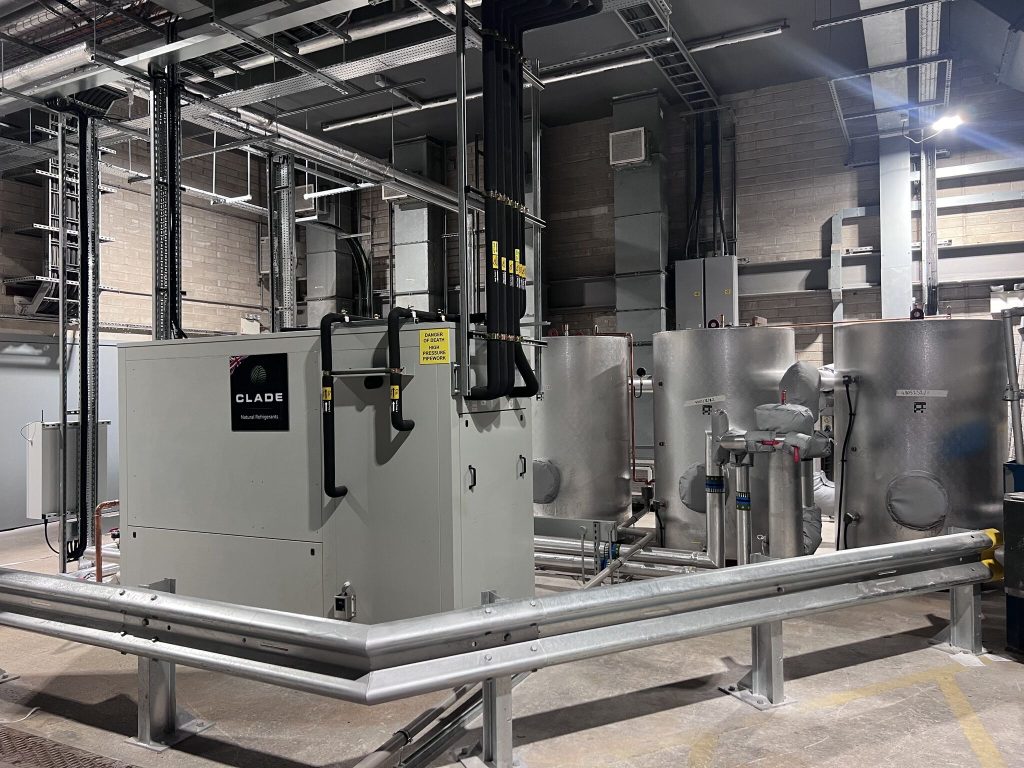
The minimum clearance around any Clade unit is 1 metre all around.
Likewise, if working in an electrical panel, there needs to be a minimum of a meter space, to prevent somebody from getting an electric shock and then becoming trapped.
Safety vent valves
A very common CDM issue with buffer vessels is placing the safety valve on top of the vessel.
This can then make the vessel unmaintainable because the valve is out of reach.
Final thoughts
Buffer vessel design is rarely a one-size-fits-all exercise.
Required system volume, load profile, refrigerant selection, defrost strategy, and plantroom constraints all influence the final specification.
However, one of the key advantages of Clade heat pumps is that hot gas defrost removes the need to size buffer vessels around defrost requirements.
This gives designers added flexibility with buffer sizing, as well as the opportunity to reduce plant space requirements – all while maintaining reliable performance.
Need support with buffer vessel sizing, system design, or heat pump specification? Just get in touch.
Our team works closely with consultants, designers, and contractors across the UK. We’re always happy to help.