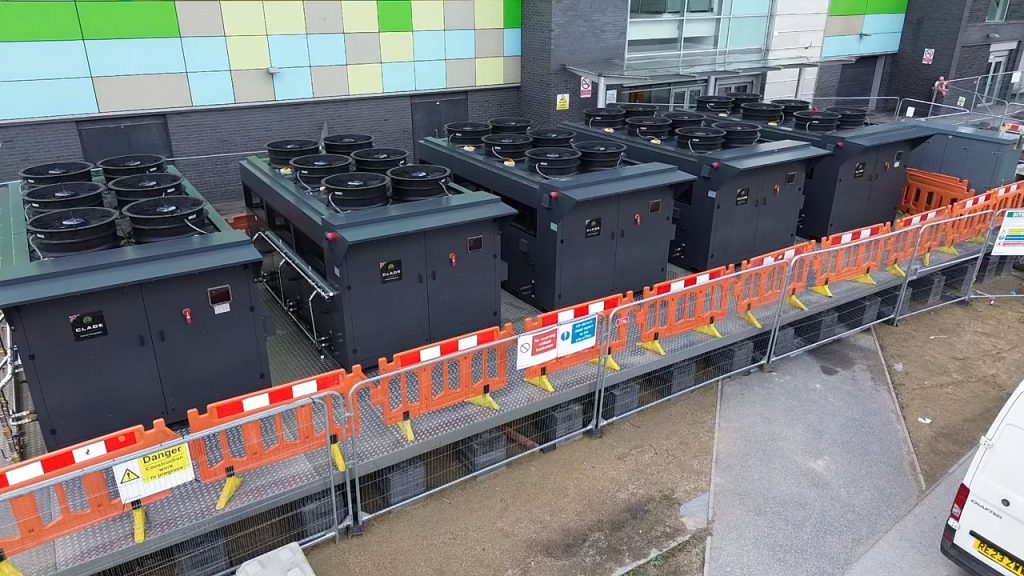
When it comes to heat pump performance, system design is everything. The most efficient equipment can easily underdeliver, or overconsume electricity, without a design that fits the building, the emitters, and the demands of the occupants.
That’s why heat pump system designers have become increasingly central to successful low-carbon projects, whether in new builds, deep retrofits, or public sector decarbonisation schemes.
Whether you’re a heating engineer, M&E consultant, or installer looking to upskill, this post will help you avoid the common pitfalls and design for real-world performance.
What Does a Heat Pump Designer Actually Do?
A heat pump designer is responsible for the overall performance of the heating system, not just selecting a unit, but ensuring every component in the chain is sized, matched, and configured correctly.
That includes:
- Room-by-room heat loss calculations
- System sizing and unit selection
- Emitter compatibility (e.g., radiators or underfloor)
- Hydraulic layout, flow rate, and pipe sizing
- Control strategy and integration
- Planning constraints (e.g., MCS sound thresholds)
As low-temperature heating becomes the norm, more emphasis is being placed on designers to avoid oversizing, maintain high COPs, and deliver systems that work day-to-day, not just on paper.
Step 1: Accurate Heat Loss Calculations
Every good system starts with a heat loss calculation, and that means considering every single room.
This involves:
- Measuring floor areas and room volumes
- Applying U-values for floors, walls, roofs, and glazing
- Accounting for air changes per hour
- Factoring in orientation and exposed surfaces
- Estimating internal gains and comfort setpoints
Don’t just apply a blanket 50–60W/m² figure. Room-specific calculations prevent oversizing (which kills efficiency) or undersizing (which leaves clients cold).
In the commercial heating world the use of simulation and modeling tools is common. The whole building can be simulated in various weather scenarios and with different use patterns. Getting as close to the actual heat demand as possible is vital so the heat pumps are not oversized. Which leads to challenges with DNO applications and a greater project cost than necessary.
Clade’s design team offers technical input and templates to support specification across large-scale or complex projects.
Step 2: Choosing the Right Heat Pump
Once you’ve determined the peak heat load, you can size the unit. But don’t fall for the nameplate. Heat pumps perform differently at different outdoor temperatures. You must factor in:
- Local design temperatures
- Output drop-off at low ambient
- Required system flow temperature (e.g., 35 °C vs 60 °C)
Clade’s range accounts for this with published performance curves:
- The Rowan R290 SN/375 delivers 400 kW at -5 °C and up to 600 kW at +7 °C, with 65 °C flow and scalable modular control.
- The Maple CO₂ SN/500 delivers up to 500 kW of heat at -5 °C, reaching 70 °C flow at high efficiency, ideal for process and high-temperature space heating.
Always use published performance data at your design point, not peak output under ideal conditions.
Example: If a unit is rated 12 kW @ 7 °C but delivers only 8 kW @ -3 °C, and the building needs 10 kW at design temp, you’ll fall short.
Step 3: Emitter Sizing for Heat Pump Flow Temperatures
Heat pumps operate best with flow temperatures between 35–60 °C, also the optimal temperature differential will be different depending on refrigerant and heat pump design e.g. CO2 heat pumps have a TD of up to 40C. Boiler-era emitters aren’t always compatible, and sizing must reflect this. All heat pumps will be more efficient at low flow temperatures (with the exception of CO2) however some buildings can not be modified and so the designer has to make a compromise decision between what can be achieved in the building with heat pump efficiency.
For example, radiators may need to be 2–2.5x larger to achieve the same heat output at 45 °C flow compared to 70 °C. Designers should be familiar with mean water temperature and good practice for sizing emitters. Underfloor heating, fan-assisted LSTs, or high-surface-area radiators are all strong options which can be used with heat pumps. .
For context:
- Clade’s Rowan supports 65 °C flow with a 10°C TD, offering wider emitter compatibility
- The Elm HT R290 unit offers up to 80 °C flow on a minimum of 10°C TD which is ideal for legacy system replacement
- Maple CO₂ heat pumps perform most efficiently with return temperature of30 °C. Emitter and flow design must maintain this for optimal COP
Emitter design must consider Delta T, mean water temperature, and comfort setpoints per room.
Step 4: Hydraulic Layout, Pipework and Flow Rates
It is essential that the design of the LTHW system provides sufficient flow and temperature control at the heat pump to balance the flow of the refrigerant in the heat pump. If this flow balance is achieved the heat pump will work at optimal efficiency.
The LTHW system also has to provide the flow and temperatures for the heat emitters and DHW systems. Getting these two factors to align under all conditions (e.g. consider flow at the lowest demand as well as the highest) is the designers role.
To ensure stable operation, consistent flow rates, and optimal return temperatures, your hydraulic layout needs to be thought through from the start, especially in multi-zone, larger-scale, or high-flow systems.
Good and best practice for LTHW system design are widely published in guides from CIBSE and ASHRAE as well as many other industry bodies. Design Engineers should keep themselves updated on the current recommendations.
Manufactures of heat pumps, such as Clade, are also really good sources of knowledge as they often have experience across many different design types, as well as a deep understanding of what their heat pumps need.
Clade heat pumps like the Maple CO₂ and Rowan R290 benefit from smart control and modular capacity. Our inverter controlled compressors work together with the PIC valves on the LTHW side to deliver efficient variable capacity that matches what the heating system is using.
Ultimately heat pumps can only work reliably and efficiently if the LTHW system is designed, installed and commissioned correctly.
Step 5: Don’t Forget Sound Levels
Noise is one of the most significant factors in heat pump design. The location in relation to noise sensitive areas such as houses and the effect of the local surroundings must be taken in to account. Every site is different and therefore needs individual consideration by the designer.
Clade manufactures some of the lowest noise heat pumps available which deliver exceptional heat performance whilst keeping quiet.
Other heat pumps may need to be treated with measures such as expensive acoustic enclosures, fences etc.
Designers should also consider factors such as the time of operation,for example heat pumps can be controlled to only run at low capacity or not at all overnight.
Common Mistakes in Heat Pump Design
Here are five pitfalls to avoid:
1. Skipping detailed heat loss: Relying on assumptions leads to oversizing.
2. Not calculating the flow at the low demand condition will result in poor control.
3. Not detailing the commissioning settings of valves and pumps means the site team can’t commission correctly.
4. Not thinking through maintenance and service access when placing the heat pumps so they can’t be safely accessed.
5. Not ensuring that there is good airflow around the heat pumps, ASHPs suck in alot of air so space equals efficiency.
Training for Heat Pump Designers
Looking to upskill or improve your next design?
- Download Clade schematics, emitter charts, and performance data via the document library
- Explore Clade’s modular product range for scalable commercial and industrial installations
- Reach out to Clade’s support team for help with layout, capacity matching, and commissioning

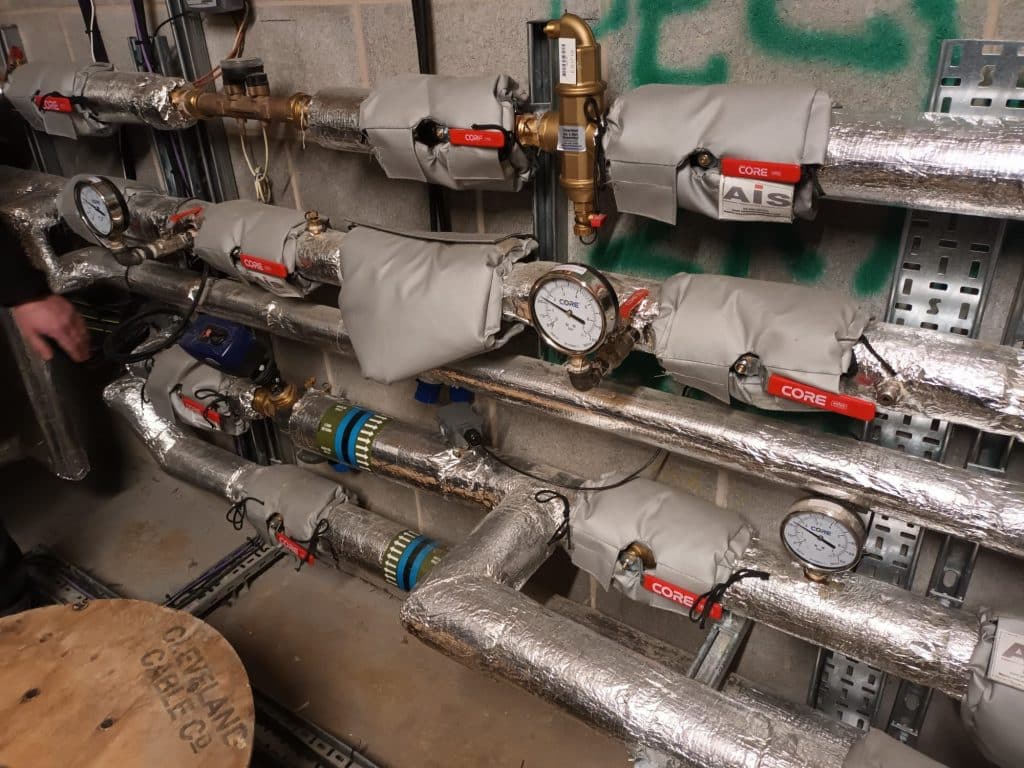
Maintaining the correct temperature differential (DT) in a heat system is essential for the operation of any heat pump.
Valves are an essential part of that system – playing a vital role in controlling both temperature and flow at many points.
Here, we’ll cover two key uses of control valves that we’ve found to work well in many applications. But first…
Why is DT so important?
DT, also known as Delta T, is the difference between the flow and return temperatures.
Essentially, flow temperature is the temperature that your heat pump heats your water to before it gets sent to your emitters (usually, your radiators).
Meanwhile, the return temperature is the temperature at which that water returns to your heat pump after flowing through your emitters.
Every refrigerant has an optimal DT – meaning it has flow and return temperatures at which it’s able to operate most efficiently.
Heat pumps generate heat at a temperature much closer to the flow temperature than boilers. And because the DT of the refrigerant is critical to both efficiency and internal pressure management control of system, DT is vital to success.
For example, CO2 (R744) is most efficient with a 70C flow and 30C return. While some CO2 heat pumps can certainly tolerate higher return temperatures, this will compromise their efficiency.
With that in mind, heat pump designs should be predicated on achieving a refrigerant’s optimal temperatures.
This will not only enhance heat pump efficiency but it will also, in doing so, allow end users to maximise carbon savings and minimise energy costs.
Luckily, control valves can play an important role in both flow control and temperature management – two factors that are key to maintaining optimal DT. Which brings us onto…
Managing return temperatures
Pressure Independent Control Valves (PICVs) integrate the functions of a differential pressure regulator, a control valve, and a flow limiter into a single unit.
PICVs may be used in many parts of the system. For example: on each radiator, on a heating circuit, or on the main return to the heat pump.
But in systems utilising natural refrigerant heat pumps, PICVs are particularly advantageous.
This is because of the huge role they can play in managing return temperatures.
1. Stable flow control
PICVs automatically adjust to maintain a constant flow rate regardless of variations in system pressure.
This is critical in ensuring that heat transfer and energy extraction are consistent, which stabilises the return temperatures of LTHW systems.
2. Prevention of overheating
By maintaining precise flow limits, correct control of PICVs prevents excessive heating of the return water.
This is essential for CO2 heat pumps, which require a 30°C return temperature to operate within their efficient supercritical range.
3. Dynamic adjustment
PICVs respond dynamically to changes in demand from signals via the control panel, such as fluctuating heating requirements across zones.
This adaptability ensures that the return water temperature remains within design limits.
PICVs should be specified to be fast-acting in order to react in sufficient time to give good control.
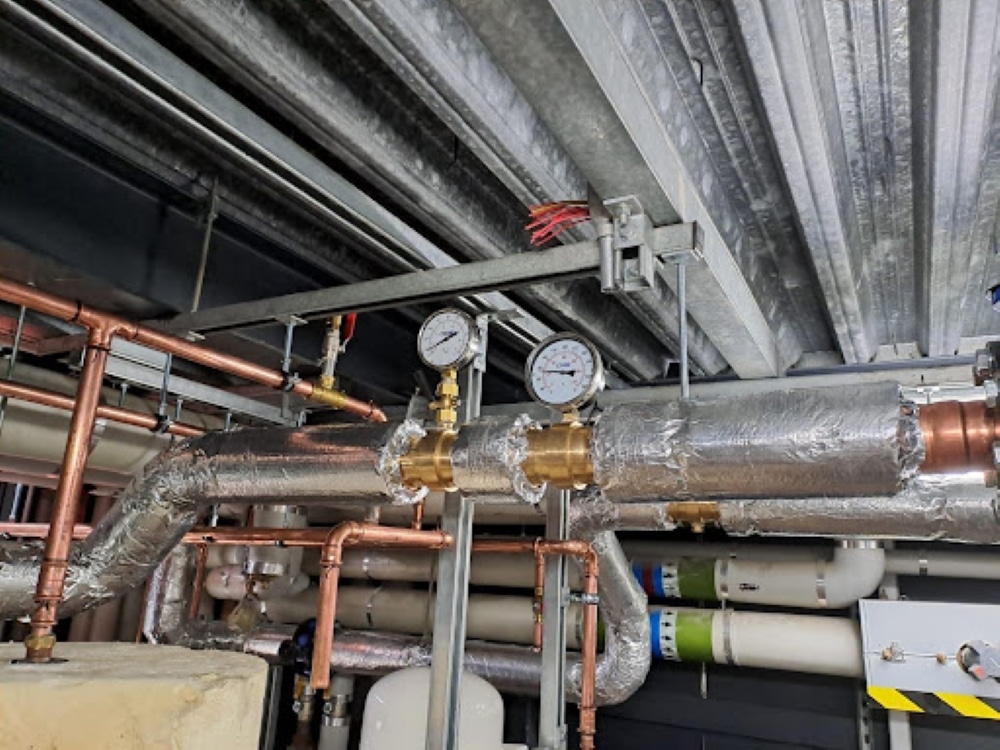
Temperature control
3-port diverter valves play a critical role in maintaining optimal return temperatures in systems that use propane refrigerant heat pumps.
They do this by ensuring the heat pump operates within its design parameters.
Here’s what their role in temperature control strategy looks like.
- The valve maintains a consistent return temperature set point, depending on the system design requirements
- If the return temperature falls below the set point, the valve modulates to divert flow from the flow line, mixing it with the return water to raise the temperature
- This strategy ensures the heat pump maintains the required DT between flow and return temperatures, which is critical for achieving efficient heat transfer and system stability
In this way, 3-port diverter valves can safeguard your heat pump from inefficiencies or operational issues that could arise from improper temperature differentials.
Plus, by maintaining the DT, they can support the heat pump in achieving its target flow temperature, which ensures reliable and consistent heating delivery.

Let us worry about control valves for you
As you can see, these tiny pieces of kit have a big role to play in natural refrigerant heat pumps. And their role is highly technical.
With that in mind, it’s worth noting that any technical advice provided here is for informational purposes only.
While we strive to ensure the accuracy and reliability of the information provided, it isn’t intended to be a substitute for professional advice or services tailored to specific circumstances.
Rather, that’s what our heat pump system designers are here for!
Our system designers have a wealth of experience and will be happy to design a complete heating system that works perfectly for you and your building – from the heat pump to the control valves.
Just get in touch for bespoke advice and guidance.
]]>