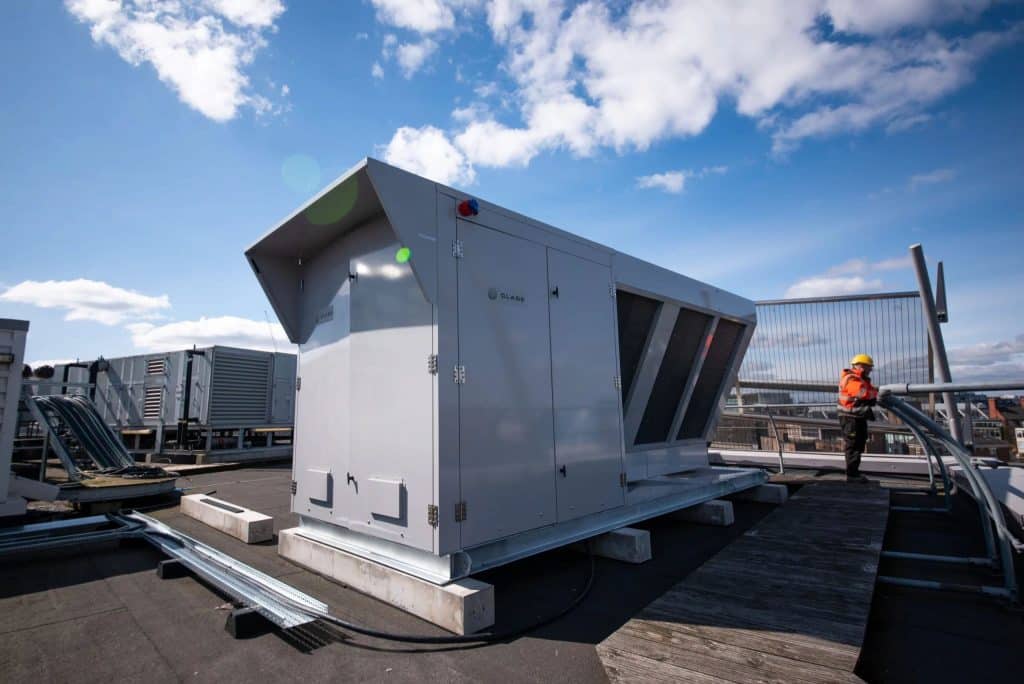
The Scottish government wants all buildings in Scotland to switch to a zero-emissions heating system by 2045 – and they’ve published a heat strategy setting out how they intend to do this.
So, if you run a business in Scotland, it’s time to start thinking about eco-friendly alternatives to your traditional gas boiler.
Luckily, an air source heat pump is a great option.
Here, we’ll cover all you need to know about air source heat pumps in Scotland – from how they work to ballpark running costs. But first…
Why does the government want you to get a heat pump in Scotland?
The push to switch to zero-emissions heating systems like heat pumps in Scotland is part of the government’s goal to tackle climate change.
According to the Scottish government, occupied dwellings currently account for 13% of Scotland’s total greenhouse gas emissions and 30% of Scotland’s total energy consumption.
Meanwhile, non-domestic buildings account for 7% of Scotland’s total greenhouse gas emissions, and 12% of the country’s final energy consumption.
With this in mind, swapping fossil-fuel powered heating systems – like gas boilers – for heat pumps and other zero-emissions heating technologies will be a big step in helping to reduce the country’s carbon emissions.
Not only are heat pumps emissions-free, but they’re also sustainable. After all, they use the air to provide heat, which is a natural energy source (as well as a small amount of electricity).
Plus, they’re three or four times more efficient than gas boilers!
By encouraging businesses and homeowners to switch to a heat pump, the government hopes to create a greener, more sustainable future that benefits both people and the planet.
Do heat pumps work in Scotland?
A common misconception of heat pumps is that they don’t work in cold weather.
However, this isn’t the case at all.
Air source heat pumps are designed in such a way that it doesn’t actually need to be warm outside for them to be able to extract warmth from the air.
In this way, they’re able to maintain consistent indoor temperatures throughout the year, regardless of variable ambient conditions.
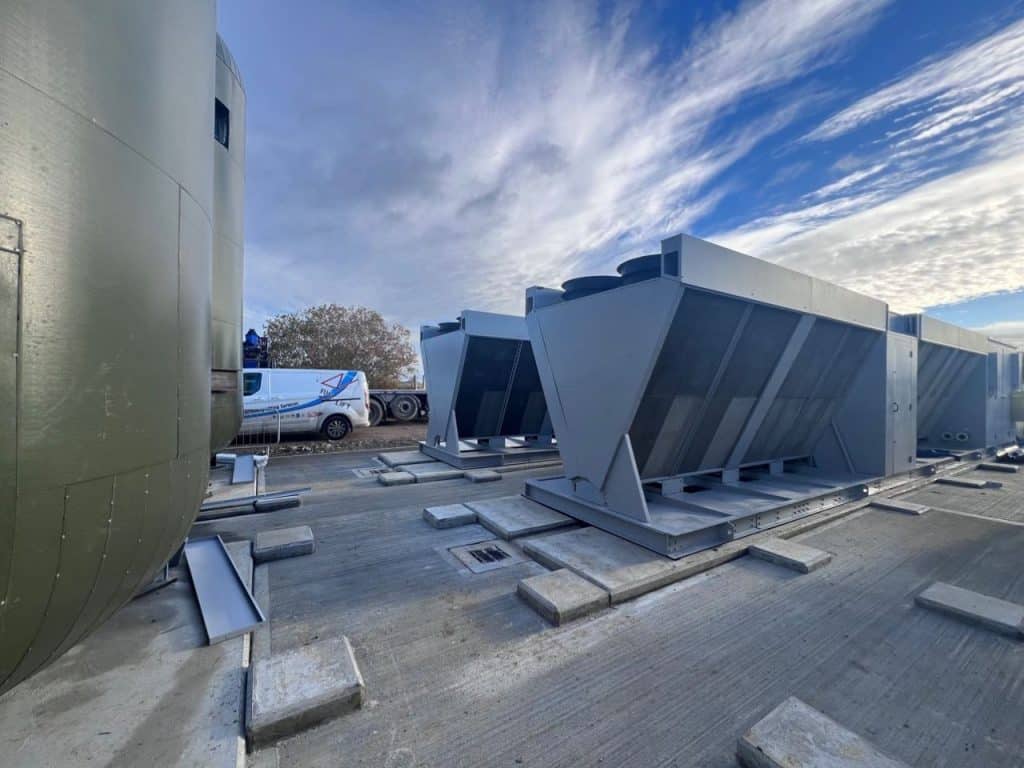
In fact, heat pumps have been proven to work reliably even in the coldest parts of Scandinavia, where temperatures regularly drop well below freezing.
At Clade, our CO2 heat pumps can operate at extremely low ambient temperatures, due to the fact that CO2 works at a higher pressure than other refrigerants and therefore the compressor envelopes are much wider.
Ultimately, it’s your heat pump designer’s job to design a heat pump system that will work for your business’ needs throughout the year. They’ll factor in your ambient temperatures and usage to ensure they design a system you can confidently rely on whatever the weather.
Is it worth getting a heat pump in Scotland?
Yes, getting a commercial heat pump in Scotland is absolutely worth it.
Not only are heat pumps eco-friendly and reliable, but they can also help you to lower your energy bills and even futureproof your system against future regulatory changes.
To help you weigh up your decision, here are a few heat pump pros and cons to consider (as you can see, the positives far outweigh the negatives!).
Benefits
1. Eco-friendly
As we’ve touched upon already, heat pumps are a sustainable and zero-emissions heating system.
2. Efficient
Air source heat pumps can reach a whopping 300% efficiency.
This is because they transfer heat from one place to another using a small amount of electricity, rather than generating heat from scratch.
3. Lower energy bills
Just 30% of the energy used by an air source heat pump is typically provided by electricity – the rest is generated by the environment for free!
4. Long lifespan
Heat pumps typically last for over 20 years – around double the lifespan of a gas boiler.
5. Futureproof
Switching to a heat pump will prevent your heating system from becoming a stranded asset in the face of upcoming boiler bans.
Opting for natural refrigerants (like those we offer at Clade) will also help you to safeguard your system against tightening fluorinated gas regulations.
6. Reliable
Air source heat pumps can maintain consistent indoor temperatures throughout the year, regardless of variable ambient conditions.
7. Versatile
Retrofitting an air source heat pump is achievable in most buildings. Likewise, heat pumps can be used for both space heating and domestic hot water (DHW).
8. Controllable
Heat pumps are easy to use and can integrate with a range of controls – including as part of a wider climate-controlled system.
At Clade, the majority of our heat pumps are remote monitoring and smart-enabled too.
9. Corporate social responsibility (CSR)
Being an early adopter of heat pump technology can help businesses to reassure clients of their commitment to the environment. In this way, it can become a powerful marketing tool.
Disadvantages
1. Upfront costs
Heat pumps require a significant upfront investment. In fact, The Guardian estimates that a heat pump costs four or five times more than a gas boiler for supply and installation (although we can expect to see this gap close over time).
However, there are financial incentives available to encourage organisations to make the switch (we’ll cover these shortly).
2. Upgrades often required
Most buildings (but not all) will require some upgrades to maximise the potential of a heat pump system – for instance, upgrading emitters, pipework or insulation.
3. Unfamiliar
Heat pumps are still a relatively new technology. Although they’re easy to use and control, they’re unknown territory for most people.
This means they can take a bit of getting used to, and there can be an element of fear to overcome too.
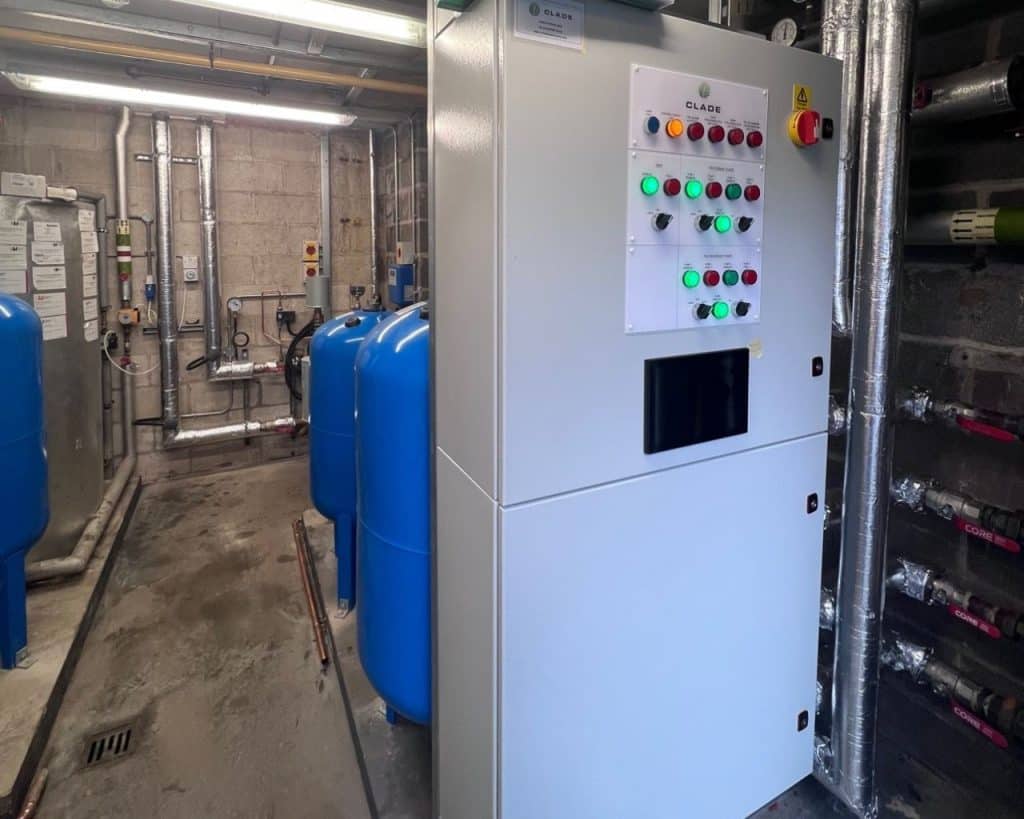
How much does a heat pump cost in Scotland?
When it comes to the cost of a commercial heat pump, there are a few aspects to consider:
- Upfront cost
- Running costs
- Cost savings
Heat pumps require a significant initial investment.
But it’s important to look at the long-term financial impact of your heating system – moving from a cost to an efficiency model.
Installation costs
The initial cost of a commercial heat pump in Scotland can vary hugely depending on the needs of each individual business.
To give you an example, heating a factory is very different from heating an office or even a swimming pool!
Overall costs typically vary based on factors like:
- The size of your building
- How well the building is insulated
- System power and efficiency
- Your heat requirements and usage (eg. required room temperature, space heating vs DHW etc.)
- Any noise reduction features needed
That said, as a rough guide, The Guardian estimates that a heat pump costs four or five times more than a gas boiler for supply and installation.
Running costs
Heat pumps can reduce your energy bills significantly.
This is because, even though electricity is currently more expensive than gas, only 30% of the energy used by an air source heat pump is typically provided by electricity. The rest is generated by the environment for free.
Not only that, but the electrification of heat opens the door to using electricity at times when it’s cheap.
By pairing a heat pump with thermal storage, you can run your heat pump when the cost of electricity is low, and use the heat generated when it suits your needs.
Likewise, although most businesses will get the electricity they use to power their heat pump from the National Grid, there’s also the option to power your heat pump using renewable energy sources.
If you generate your own electricity using solar or wind power, your heat pump will be completely free to run (other than occasional maintenance costs).
Read our guide to heat pump running costs to learn more.
Heat pump incentives in Scotland
The good news is that, if you’re eligible, there is financial support available to help you switch to a zero-emissions heating system.
In Scotland, small and medium-sized enterprises (SMEs) can apply for an SME loan of up to £100k to help pay for energy and carbon-saving upgrades.
If you’re eligible, you could also receive a cashback grant of up to £30,000 to help towards the cost of installing a heat pump.
Other incentives available include:
- Public Sector Decarbonisation Scheme (PSDS) provides loans
- Social Housing Decarbonisation Fund (SHDF)
- Tax breaks under the HMT expensing policy
Just bear in mind that most of these (other than tax breaks) are only available to public-sector organisations.
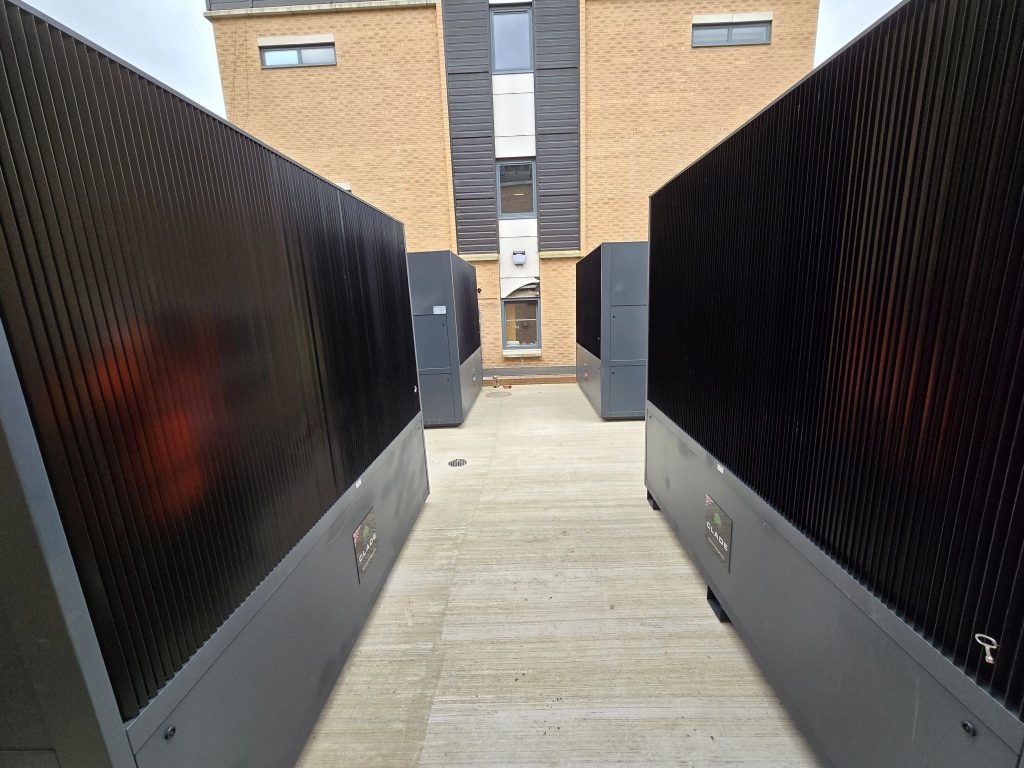
Installing a heat pump in Scotland
Contrary to what you might think, heat pumps aren’t just suitable for new builds.
Rather, they can be retrofitted in most existing buildings in Scotland.
In particular, air source heat pumps are generally easier and less expensive to retrofit than their ground source and water source counterparts, making them a great option for businesses around the country.
In fact, at Clade, we’ve supplied air source heat pumps to buildings ranging from schools to libraries, office buildings to factories, and even swimming pools!
Most buildings will require some upgrades to maximise the potential of a new heat pump system.
For example:
- Emitters. Heat pumps typically (but not always) run at lower flow temperatures than boilers, meaning they tend to require larger emitters for the same heat output.
- Pipework. Depending on your building’s existing heating system and the refrigerant used in your heat pump, you may need to upgrade your pipework.
- Insulation. Upgrading your building’s insulation can reduce heat loss, therefore reducing the size of heat pump needed and the energy bills for operating it (although heat pumps are available in any size and can meet any heat demand).
However, choosing a refrigerant with a similar temperature differential (or Delta T) as those used by traditional boilers – like the natural refrigerant R290 (propane) – can help to minimise the number of changes that you need to make to your building’s existing infrastructure.
In fact, even if it isn’t possible to make upgrades to your building, you may still be able to benefit from a heat pump.
Our new Elm heat pump acts as a direct boiler replacement and is designed especially for buildings where the existing infrastructure can’t be easily amended.
Planning permission for air source heat pumps in Scotland
Nearly every commercial heat pump installation has planning requirements that specify noise.
However, there’s a large variation between planning authorities.
Plus, the real world behaves differently and is more complex than the simplistic engineering models that are typically created during the design phase.
Here are some factors relating to noise and planning to bear in mind.
Manufacturers’ data
There’s no set standard for what noise data has to be published by a manufacturer.
At Clade, we test our heat pumps in real-world conditions in accordance with BS EN ISO 9614 – Part 1: 2009 and BS EN ISO 4871: 2009. This gives much higher confidence in the end result than a lab condition test with a perfect unit.
Head over to our guide on heat pumps and noise to learn more about how we’re breaking barriers in this field.
Location and surroundings
Hard surfaces reflect sound, metal frames transmit sound, and curved surfaces amplify sound.
The same heat pump in a tight urban space will have completely different effects than one on an open roof.
Mitigation measures
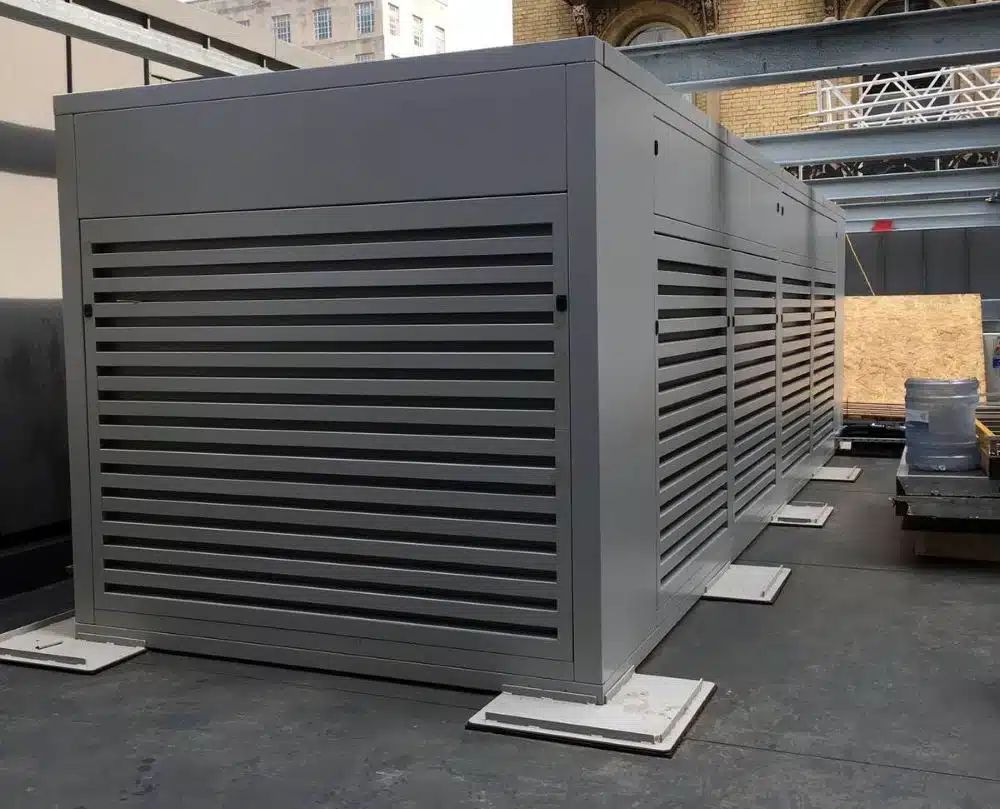
Fences, enclosures and other external things can be used to reduce noise.
Read our blog on heat pump covers to learn more.
Uncertainty
It is a fact that measuring instruments, manufacturing tolerances and installation conditions all have unknowns that make precise measurement impossible.
We work on a +/- 4 db uncertainty value.
Low-noise technology
At Clade, we’re continuously working to improve our low-noise technology and negate the need for external noise-mitigation measures.
Our new Acer 2 model harnesses our WhisperShieldTM technology to reach just 33 dB at 10m.
Talk to us about installing an air source heat pump in Scotland
As you can see, installing an air source heat pump in Scotland comes with a ton of benefits.
By replacing your commercial boiler for a heat pump, you’ll be reducing your business’ carbon footprint, lowering your operating costs, safeguarding your heating system’s future, and providing your building with reliable space heating and (if you choose to) DHW.
In this way, it’s a win for the planet, your business and the people in it.
At Clade, we have over 35 years of experience working with natural refrigerant heating and cooling systems. So, you’re in safe hands with our expert team of engineers and designers.
Simply get in touch to learn more about how we can help your business to switch to a heat pump in Scotland.
]]>